
* In the wake of the failure of Confederate General Braxton Bragg to decisively defeat the Union in central Tennessee in the fall of 1863, Bragg was replaced by General Joe Johnston. There was necessarily little activity during the winter, but come early spring, action began to pick up, with Union General William Tecumseh Sherman sacking Meridian, Mississippi, with an eye towards an offensive south towards Atlanta in Georgia, then in consideration. In the meantime, Johnston's cavalrymen, most notably Nathan Bedford Forrest, conducted raids to keep Sherman off balance.

* In September 1863, Union and Confederate forces fought a bloody battle at Chickamauga Creek in north Georgia, with the Federals getting the worst of it, and falling back to Chattanooga, Tennessee, where they were besieged by the Confederates. The Yankees, having obtained reinforcements, broke out of Chattanooga in November, driving Confederate forces off of Missionary Ridge above the city.
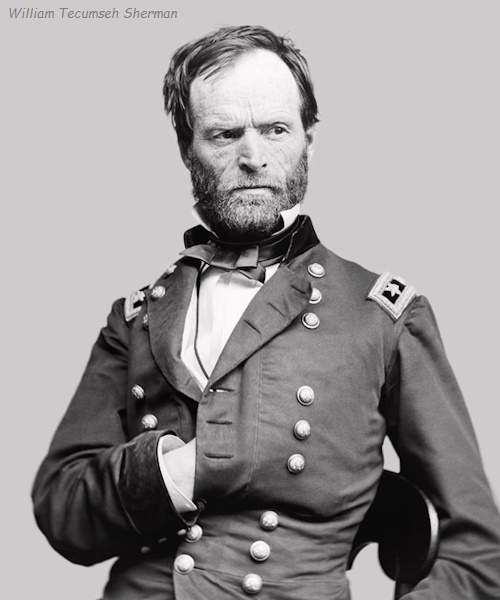
There was little more fighting in the area for the rest of the year. Union Major General William T. Sherman, then in command of the Union Army of the Tennessee, later wrote: "The winter of 1863-64 opened very cold and severe, and it was manifest that military operations must in a measure cease." Sherman and his superior officer, Major General Ulysses S. Grant -- at the time the commander in the West -- retired to the relative comfort and central location of Nashville.
After the Battle of Missionary Ridge, the dispirited Confederate Army of the Tennessee, under General Braxton Bragg, had regrouped in Dalton, Georgia, a few days' march southeast of Chattanooga. Even if the weather had been more suitable for campaigning, Bragg's army was too weak to take the offensive. There were also two Confederate divisions under Lieutenant General James Longstreet in the mountains of Tennessee, east of Chattanooga; in September, they had been loaned from General Robert E. Lee's Army of Northern Virginia to assist Bragg. In November, Longstreet's force had been dispatched to the hill country to deal with the Yankees there. It was a fool's errand since the Federals there were more numerous, and the sole result was Longstreet's disastrous and futile assault on Knoxville at the end of the month. The survivors were in miserable condition, and also no threat to the Federals.
The Federals were much more of a threat to the Confederates. Once spring came, Chattanooga would be a springboard for a drive into Georgia. In preparation for that time, the Yankees began to build Chattanooga into a major supply depot for future operations. Bridges were built, tracks were laid, and huge stockpiles of supplies began to accumulate in the town.
There were other matters to attend to, such as the burial of the battle dead in a new military cemetery in the shadow of Lookout Mountain, to the southwest of Missionary Ridge. The chaplain in charge of the effort asked Major General George H. "Pap" Thomas, in command in Chattanooga, if he wanted to arrange the dead in sections by state, as had been done at Gettysburg. Thomas thought it over for a moment and replied: "No, no, mix 'em up, mix 'em up. I'm tired of States' Rights."
The normally placid Thomas was in high spirits. His men had spontaneously handed him the glory of a victory, making him the hero of the hour, when others such as Sherman were to have been the stars. Thomas had also had more than adequate revenge on Confederate General Braxton Bragg, who had been Thomas' commander in the US Army before the war, and had labeled Thomas a traitor for siding with the Union.
Bragg was completely humiliated by the defeat. However much he could -- and did -- complain that his men had behaved disgracefully on the field of battle, he could not conceal, even from himself, the fact that what little confidence they had ever had in him had evaporated. The soldiers had mocked his attempts to rally them in the battle, and now that they were all consolidated in Dalton, Georgia, the spirit of mockery continued. Bragg wrote the Confederate government in Richmond, Virginia: "I deem it due to the cause and to myself to ask for relief from command and an investigation into the causes of defeat."
That may have been sincere, but it may have also been a ploy, with Bragg gambling that the investigation would exonerate him. If so, he lost the bet. On 30 November, he was informed that he was relieved from command, being told that Lieutenant General William J. Hardee would take his place. Bragg used his unceremonious exit as an opportunity to fire parting shots at his lieutenants, who had no high opinion of him: "The disaster admits of no palliation, and is justly disparaging on me as a commander. I trust, however, you may find upon full investigation that the fault is not entirely mine ... " He then proceeded to suggest those among his lieutenants, particularly Major Generals John Breckinridge and Ben Cheatham, where the fault could also be placed.
It was what might be expected of him. Within a few days, Bragg was on a train rolling east towards Richmond, where he had been ordered to report, with the Confederate government to decide what to do with him. He would never get another field command.
BACK_TO_TOP* The resignation of Bragg left Confederate President Jefferson Davis with the problem of filling the vacated position with another general. Hardee declined to take the job except on a temporary basis. After further efforts, Davis found out his only option was General Joe Johnston. The two men had never got along, and Davis was not enthusiastic about appointing him.
Unfortunately, disagreeable choices were the only ones Davis had left. That applied not just to the selection of generals, but to the entire Southern war effort. The discomfort of his position was emphasized by an address given to the Confederate Congress on 8 December 1863. In his speech, Davis could point to few military successes, none of them were comparable to the defeats inflicted at Gettysburg, Vicksburg, and Chattanooga. Hope of foreign intervention was completely dead, and the Confederate government was penniless. The single hope Davis could offer was that continued Southern resistance to the Union power might make the Northern people grow weary of the bloodshed. He appealed to Southern patriotism to carry on the fight.
Following the speech, Davis then returned to the issue of replacing Bragg. Confederate Secretary of War James Seddon was fond of Joe Johnston, though even he admitted that Johnston lacked aggressiveness -- Johnston's critics went farther, saying that the only thing the general knew how to do was retreat. The debate lasted a week, but in the end no alternative to Johnston could be identified, and won on a vote. Although those who voted against him detested the idea of putting him in command, they couldn't propose any substitute. On 16 December, Seddon wired Johnston, who was at Meridian, Mississippi:
   YOU WILL TURN OVER THE IMMEDIATE
   COMMAND OF THE ARMY OF MISSISSIPPI
   TO LIEUTENANT GENERAL POLK AND
   PROCEED TO DALTON AND ASSUME
   COMMAND OF THE ARMY OF TENNESSEE.
Johnston would receive complete instructions on his arrival in Dalton.
* Joe Johnston left Meridian, Mississippi, by train on 22 December, after arranging transfer of his command to Lieutenant General Leonidas Polk, and arrived in Dalton, Georgia, on 26 December. On his arrival, he received and read his instructions from War Secretary Seddon and President Davis. They both encouraged him to take the offensive and did everything they could to proclaim their confidence in him and his ability to turn the unfortunate Army of Tennessee around. They were trying to be tactful and mend fences. Johnston wasn't interested in returning the favor, flatly replying that taking the offensive was out of the question, detailing at length the impossibility of the task. That was realistic, but it was also exactly the attitude that Jefferson Davis had expected. Relations between the two men immediately went back to their traditional frosty state.
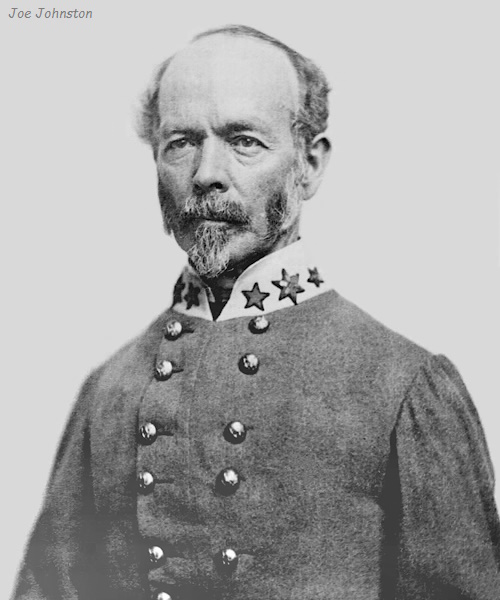
Johnston's arrival in Dalton demonstrated his long-standing touchy attitude toward his superiors, as well as his kindly attitude toward his subordinates. He improved rations, got his men better clothing, and instituted a system of furloughs. Most importantly, he mingled continuously among his men, shaking hands and speaking to them as if they were his own family -- which they were, as far as Johnston was concerned.
He could be a stern father on occasion, ordering the execution of soldiers who simply would not get with the program. They were stood in front of open graves with the troops lined up to watch, with the sinners shot and buried on the spot. Johnston took such measures only when necessary. After enduring Braxton Bragg, who had been more enthusiastic about the stick than the carrot, the men thought they had gone to heaven. They cared for Johnston as he cared for them. One day after Johnston's arrival, Major General Cheatham took some of his men and a regimental band over to Johnston's tent, and serenaded him as a welcome. Johnston came out to thank them, and Cheatham introduced him by patting him gently on the head and announcing: "Boys, this is Old Joe."
* Although the Confederacy's difficulties might have seemed overwhelming to most, some rebels didn't care. One was the famed Confederate cavalry raider Nathan Bedford Forrest, now a freshly-minted major general. He had arrived in Northern Mississippi in mid-November with only about 300 men. That was a ridiculously small command for someone of his rank, but not really a problem: Forrest was perfectly capable of building his own command as it suited him. At the end of November he left Northern Mississippi, taking his men behind Federal lines into West Tennessee to recruit volunteers and collect supplies. He returned by New Year's Eve with a total of about 3,500 men, plus many pigs and livestock, as well as forty wagonloads of bacon.
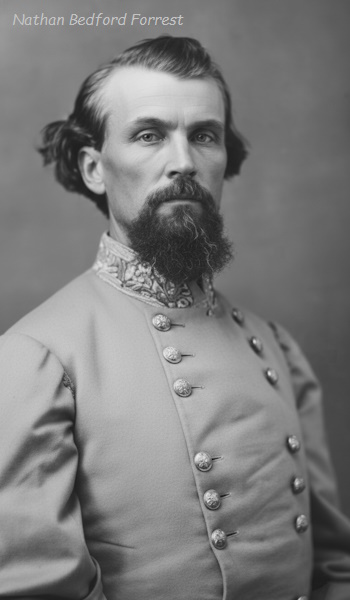
The troops were of questionable value. Nearly all the men in West Tennessee who had any real will to fight for the Confederacy were either in the ranks or were now dead or maimed, leaving only deserters and other faint-hearts. General Sherman, on hearing about Forrest's recruiting drive, dismissed it: "Forrest may cavort about that country as much as he pleases. Every conscript they now catch will require a good man to watch."
Sherman still knew better than to underestimate Bedford Forrest: if anyone could make good troops out of such unpromising material, it would be Forrest. Despite his lack of formal military background, he had a natural understanding of drill and discipline, backed up by thrashings if it came to that, plus firing squads in the limit. In itself, such treatment would have earned him as much respect as it had earned Braxton Bragg; the difference was that Forrest was a tiger, a fighter and a winner, and he had the ability to instill that tiger spirit into his men -- teaching them that they were an elite, more than a match for any Yankees.
BACK_TO_TOP* While Lincoln considered re-election, Union Major General Ulysses Grant was considering what he could do to crush the Confederacy once and for all. In mid-December, Grant had sent Charles Dana -- a War Department official who had been assigned to keep tabs on Grant, only to become a Grant disciple -- to Washington to present some ideas for strategies to senior Federal officials. After consultations, Dana replied that President Abraham Lincoln, War Secretary Edwin Stanton, and nominal Army commander Major General Henry Halleck had rejected Grant's proposals for various reasons -- but Dana added that the President said any further ideas were welcome.
In January, Grant had written Halleck a letter outlining the possibilities for future campaigns. In the West, Grant proposed to send Sherman out of Vicksburg to destroy the vital rail center at Meridian, Mississippi, generally raise hell in the state, and then fall on Mobile, Alabama.
Sherman had been lobbying Grant since mid-December for such an operation. Sherman didn't like leaving his men idle over the winter, and Confederate guerrillas had been active along the Mississippi, taking pot-shots at steamboats. Sherman feared that if the guerrillas were not suppressed, they would soon form up bands and fall on Federal garrisons in the region. Sherman intended to deal with the problem by simply spreading so much destruction through the region that guerrillas would have no means of subsistence, while teaching them fear of Union power. He put it bluntly:
QUOTE:
To secure the safety of the navigation of the Mississippi River, I would slay millions. On that point, I am not only insane, but mad ... I think I would see one or two quick blows that will astonish the natives of the South and will convince them that, though to stand behind a big cottonwood and shoot at a passing boat is good sport and safe, it may still reach and kill their friends and families hundreds of miles off. For every bullet shot at a steamboat, I would shoot a thousand 30-pounder Parrotts into even helpless towns on Red, Ouachita, Yazoo, or wherever a boat can float or soldier march.
END_QUOTE
Once Mobile was secure, Sherman would then shift to Chattanooga and lead his army towards Atlanta, while McPherson led another force from Mobile to capture Montgomery, the state capitol of Alabama.
* Confederate General Polk had two divisions at Demopolis, Mississippi, to oppose Sherman's incursion into the state, and so Sherman proposed performing this massive "raid" with four divisions to keep Polk at bay. To prevent Johnston from sending forces west from Georgia to help Polk, Sherman suggested that Pap Thomas threaten Dalton, keeping Johnston on the defensive.
The only wild card was Bedford Forrest, now building up his command in northern Mississippi. Although Forrest only had about 3,500 men of uncertain quality, neither Grant nor Sherman underestimated him. As one Federal put it, Forrest was "constantly doing the unexpected at all times and places." Sherman suggested that Brigadier General W. Sooy Smith, in charge of all cavalry in the Army of the Tennessee, take a force of about 7,000 troopers from West Tennessee, deal with Forrest, and then link up with Sherman to help complete the destruction of Northern Mississippi.
Grant gave Sherman the go-ahead, though as always some changes in plans were required. The Administration was still interested in using Union forces in Louisiana to move up the Red River and penetrate Texas, and so a combined move on Mobile was out of the question. Sherman's idea for a punitive expedition into northern Mississippi was still on, however, and by 1 February Sherman had massed four divisions in Vicksburg. He completed his preparations, and moved out on 3 February 1864.
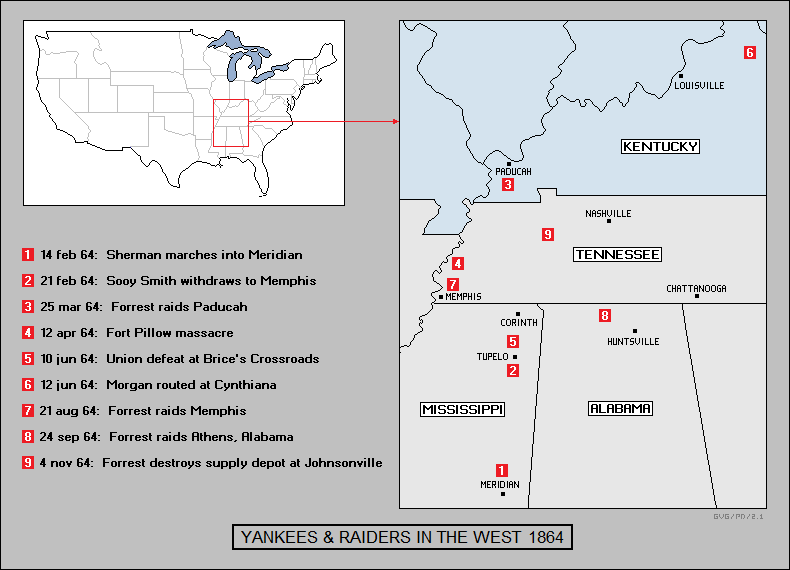
In the meantime, Polk had shifted his forces in anticipation of the invasion, setting up headquarters in Meridian and deploying two divisions around Jackson to the west. Sherman was actually very pleased at Polk's redeployment, since the Federal intruders greatly outnumbered the rebel forces; now Sherman could engage the Confederates after a relatively short march. Sherman's force, divided into two columns, moved fast, seizing Jackson on 7 February and capturing a Confederate pontoon bridge intact. The only thing the rebels could do was fall back in disarray. Although the Federals had marched through Jackson and burned it twice previously, they set the torch to it a third time just for good measure.
However, the Confederates almost got lucky on the evening of 12 February. By that time, the Federal advance was now only about 30 miles (48 kilometers) from Meridian. Sherman decided to spend the night at a local house, assigning a regiment to guard the area, but there was a mixup and the regimental commander decided to rejoin the column moving eastward. Sherman was awakened by gunfire to find rebel cavalry swarming about. Learning of the absence of the guard regiment, he sent a courier off at a dash to catch up with the regiment and tell it to come back on the double, and organized his staff for a fight. Fortunately, the Confederate troopers didn't know Sherman was there and were only interested in capturing a few Yankee wagons. Before the townspeople could tell them that a much bigger prize was near at hand, the guard regiment came back and drove the rebels off.
Sherman's men marched into Meridian in mid-afternoon on 14 February. Polk was gone, having left with the rearguard that morning by rail, after removing everything of value that they could pick up and carry off. Sherman was furious that Polk had got away. Sooy Smith's cavalry was supposed to have left Collierville, Tennessee, just east of Memphis, on 1 February, and linked up with Sherman's main force a few days earlier; far-ranging Union cavalry should have been able to cut rebel lines of communication and made the withdrawal of the Confederates far more difficult. However, Sherman had no idea where Sooy Smith and his men were or what they had been doing. Sherman in essence sighed, gave his men a day of rest, and then set them to thoroughly wrecking Meridian. He later reported:
QUOTE:
For five days, 10,000 men worked hard and with a will in that work of destruction, with axes, crowbars, sledges, clawbars, and with fire, and I have no hesitation in announcing the work well done. Meridian, with its depots, store-houses, arsenal, hospitals, offices, hotels, and cantonments, no longer exists.
END_QUOTE
Other troops ranged from town to totally uproot the railroad network in the vicinity, burning bridges and destroying culverts. They made "Sherman bowties", heating rails on bonfires of crossties and then wrapping them around trees.
Sherman impatiently waited for word from Sooy Smith. Once Smith arrived with his troopers, the combined force would then advance on Selma, Alabama, to the east. But there was no sign of them. Sherman commented: "It will be a novel thing in war if infantry has to await the motions of cavalry."
BACK_TO_TOP* The motions of the cavalry had not gone in any way that either Sherman or Smith had predicted. The first problem had been simple logistics. Smith had been supposed to leave Collierville on 1 February, but delays in the arrival of a vital brigade of 2,000 troopers led to a series of postponements, and Smith and his 7,000 cavalry didn't actually depart until 11 February.
On 18 February, Smith and his men finally reached their initial objective of Okolona, Mississippi, on the Mobile & Ohio (M&O) Railroad, where the troopers spent two days ripping up tracks and doing the best they could to break the line. Despite the fact that they had encountered no serious opposition, Smith was still far behind schedule. He was also trying to cope with lapses of discipline in his troops, particularly in the misconduct of stragglers who ranged over the countryside, stealing what they could ride off with, and burning what they couldn't. Smith gave orders that any Federal trooper caught engaged in such activities be shot immediately -- but in a battle campaign the distinction between needful and needless destruction can be hard to determine, and soldiers eager to kill their fellow soldiers tend to acquire a fatal unpopularity in the ranks.
Smith also found himself bogged down with escaped slaves who flocked to the Yankees as their saviors. He had encouraged this at first as a means of undermining the local economy, but soon he had 3,000 blacks on his hands and had no idea of what to do with them. The runaways added to the chaos by doing some looting and burning of their own.
In short, Smith found his worries piling up on each other, aggravating the tension from his most significant worry: Bedford Forrest. Sherman had emphasized to Smith that Forrest was certain to attack, and attack with everything he had. Smith was a competent regular army officer and was not lulled into complacency by the fact that Forrest hadn't showed yet. Obviously, Forrest was preparing a trap and would fall on him at any moment.
* Smith had the jitters, but his assessment of Forrest was deadly accurate. Forrest had received intelligence on Sherman's movement out of Vicksburg at the beginning of the month, but with only 3,500 men Forrest had to leave the job of dealing with such a large force of Yankees to Polk -- though as it turned out, Polk wasn't able to do very much either.
After Sooy Smith left Collierville on 11 February, Forrest quickly got word of the movement, along with intelligence on its size. The situation had possibilities, though Forrest didn't simply pitch into the Federal troopers. He was a fighter all through, but he was always a smart fighter; slugging it out toe-to-toe with a force twice the size of his own would be stupid, and Forrest was nothing that resembled stupid.
Forrest led his troopers out of his base at Panola in northwest Mississippi on a track paralleling the Federal march. He had his four thin brigades spread out to get intelligence on Smith's movements and intentions. When Smith's troopers started smashing the M&O railroad, Forrest correctly determined that Smith would move down the M&O to Meridian and link up with Sherman. Now that Forrest knew what the plans of the Yankees were, he could devise counterplans of his own.
He sent a brigade under the command of his 26-year-old brother, Colonel Jeffrey Forrest, to West Point, south of Okolona on the M&O, as bait for the Yankees, and then set up his other three brigades a few miles to the south where the Federals could be encircled and destroyed, their numbers and mobility neutralized by swampy terrain.
On 19 February, Smith had received some warning of Forrest's presence from an Indiana trooper who had been captured by the rebels but had escaped. The trooper estimated Forrest's numbers as greater than Smith. Smith was now completely unnerved. Smith's men did make contact with Jeffrey Forrest's brigade on 20 February. The rebels pulled out to lure the Yankees south into the trap. The Federals seemed to jump at the bait, but though there was fighting on the morning of 21 February, Bedford Forrest quickly realized that it was just a feint. Smith had decided to withdraw, performing a rearguard action to keep the Confederates off balance.
Forrest never stayed surprised for very long. If the Yankees were skedaddling, they were off-balance, and he could chase them and keep them off balance. If they settled into a good defensive position they would stop him cold, but if he moved fast he could make sure they never had the chance. He ordered his troopers into pursuit. On coming up to the firing line where the rearguard skirmish was in progress, Forrest saw one of his own men doing some skedaddling, having thrown away his gun and lost his hat in his panic to get away from being shot at. Forrest leapt off his horse, rushed up to the man, threw him to the ground, picked up a piece of brush, and as one witness reported later gave the fainthearted trooper "one of the worst thrashings I have ever seen a human being get."
The thrashing clearly caused a great deal of pain but not much real injury to the man, since once Forrest was finished with the beating, he yanked the man to his feet and shoved him back towards the fighting, saying: "Now, God damn you, go back to the front and fight! You might as well get killed there as here, for if you ever run away again you'll not get off so easy!" The trooper did as he was told, and the story became famous, even becoming the subject of an illustration in HARPER'S WEEKLY titled "Forrest Breaking In A Conscript".
The rebels pursued Smith's rearguard north through West Point. A few miles north of the town, the Federals took a stand on an easily defended ridge, Forrest sent a regiment around to flank the Yankees out of their position and attacked with the rest. He led from the front, shouting out: "Come on, boys!" -- using inspiration to motivate them, seeming, as one of them put it, like a piece of powerful steam machinery rather than a man. They chased the Yankees off and continued their pursuit, setting up camp that evening at a site abandoned by the Federals just in front of them, conveniently stocked with rations and forage. The next morning, 22 February, they began the chase again.
Smith could not get out of reach of the rebels, and they pressed him mercilessly. The Federals made a stand north of Okolona that morning. On arriving to inspect the situation, one of Forrest's brigade commanders said that the Yankees were preparing to charge. Forrest replied: "Then we will charge them." They drove the Union soldiers out of their position in a panic, capturing five guns.
The Federals had organized another stand a few miles to the north at Ivey's Hill. These soldiers stood and fought better, with one volley putting a ball through Jeffrey Forrest's throat. Bedford Forrest rode up to his brother's still form to find him dead, knelt there silently for a moment, and then threw his men into a fierce hand-to-hand fight in which he personally killed three Yankees. The Federals broke again, to form up yet another rearguard defense up the road. This effort failed as had the rest, but then Forrest decided to call it quits. His horses were exhausted and he was almost out of ammunition; he had to be satisfied with sending the Yankees back to where they had come from with their tails between their legs.
* Smith didn't stop running until he reached Memphis on 26 February. He had lost only 388 men of his command, but his horses were broken down and his men were deeply humiliated. Forrest's casualties were lighter, only about 144 men, and he had given his green recruits the irreplaceable taste of what it felt like to win battles. They would go on to win more of them under their stone-hard, tireless, savage, and brilliant commander.
Forest neither was nor tried to be a pleasant man, and not all of his troops admired him. High-born Southerners in his command in particular disliked him, even looking down on him, in a mad hypocrisy, for having been a slave trader before the war. One aristocratic Mississippian who had to take orders from Forrest wrote in his diary:
QUOTE:
I must express my distaste to being commanded by a man with no pretensions of gentility -- a negro trader, gambler -- an ambitious man, careless of the lives of his men so long as preferment be in prospectu. Forrest may be, and no doubt is, the best cavalry officer in the West, but I object to a tyrannical, hot-headed vulgarian's commanding me.
END_QUOTE
Such complaints made no difference at all. What counted as far as the Confederacy was concerned was that Forrest was one of the best fighters they had. His reputation continued to grow, with both sides referring to him as "the Wizard of the Saddle".
BACK_TO_TOP* Sherman had finally given up waiting for Smith on 20 February, abandoning the plan to march on Selma. Sherman led his troops west out of Meridian, taking a different route than the one they had taken to get there to ensure more destruction. They crossed the Pearl River and went into camp north of Jackson, Mississippi, on 26 February. Sherman still had hopes that Sooy Smith might show up to permit additional campaigning, but finally decided to go back to Vicksburg on 29 February, his troops following their general a few days later.
Things hadn't gone quite as planned, but Sherman had good reasons to think the campaign a success. His objective had been to wreak havoc on Mississippi to help secure his rear, and that had been accomplished, with every reason to believe it had the desired effect. On the day he returned to Vicksburg, he wrote Halleck that he had "made a swath of destruction fifty miles broad across the State of Mississippi that the present generation will not forget." He added that he had collected "some 500 prisoners, a good many refugee families, and about ten miles of negroes."
Appalled Confederate officers inspecting the devastation Sherman had left behind could only admit that his estimates of the damage were no hollow boast. There were no resources left in the area to support a rebel force of any size, and so Sherman believed he could now reduce the garrisons there, allowing the troops to be put to use elsewhere.
The biggest flaw in the operation was Sooy Smith's lamentable performance, but Sherman wasn't too surprised, having earlier suspected that Smith was too unsure of himself to take on a tornado like Bedford Forrest. Sherman still indicated his displeasure to Smith, chewing him out for "allowing General Forrest to head him off and defeat him with an inferior force."
There was nothing more to be done about it for the moment. As long as Forrest was moving and breathing he was a threat, and if Sooy Smith wasn't up to the job of putting him in his place, Sherman didn't know who he had who was. Still, Smith's failure had prevented Sherman from giving rough treatment to Alabama, but Sherman did take satisfaction from the fact that he had "scared the bishop [Polk] out of his senses." Polk, although a West Pointer, had been an Episcopal bishop of Louisiana before returning to uniform.
* Polk had indeed known fear. He had been given his first taste of the jitters in late January, when Union Rear Admiral David Farragut had shown up in the Gulf outside of Mobile Bay with a powerful fleet. Mobile was the Confederacy's last major port available on the Gulf Coast, and it was the most important piece of real estate in Polk's department.
The presence of the Union Navy strongly suggested that the Federals were preparing to seize Mobile, which would have been a major blow to the Confederacy. In reality, Farragut's action was a feint; he would remain there for about a month, scouting out the area for the time when he would come back in earnest. When Sherman began his march from Vicksburg, Polk had every reason to fear that the hammer was about to fall on Mobile, and screamed to Richmond for reinforcements. The only possible source was Joe Johnston's Army of the Tennessee, holding their position around Dalton in North Georgia, and Richmond ordered Johnston to send troops immediately.
Johnston protested that if he weakened his force, the Federal army to the north would destroy the remainder and seize Atlanta, which would be as big or bigger a catastrophe to the Confederacy as the loss of Mobile. Richmond likely expected Johnston would balk -- he so often did -- but there was enough sense in what he was saying to make the Confederate War Department hesitate.
Finally, on 16 February, Johnston received orders to send Hardee's corps to Demopolis. After four days of planning, Hardee and his men boarded trains in Dalton that dropped them in Demopolis the next day. They promptly re-boarded them to go back to Dalton, since Sherman had already left Meridian and was headed back west. The troops riding the rickety trains must have complained loudly about the ancient military game of "hurry up and wait", since they were rushed back to Dalton with even more urgency than they had been sent out. Johnston's fears seemed to have come true, since the Federals were moving against him.
* There was less to Federal aggressiveness in Georgia than met the eye. On 14 February, Pap Thomas had been ordered to make "a formidable reconnaissance" that would hopefully drive Johnston out of Dalton, giving the Federals a good jumping-off position for a drive on Atlanta when spring arrived. Thomas took his time and didn't get moving until 22 February, and by that time Hardee's men were moving up into positions to block Federal moves through the North Georgia ridges.
The two forces made contact here and there, and Thomas found the passage blocked. He called off the campaign on 26 February and pulled back to winter quarters at Ringgold, Georgia. The Federals had lost 345 men and the whole affair did not go over well with the Northern public but, like Farragut outside Mobile Bay, Thomas found the exercise valuable as preparation for the time they came back in earnest.
The Confederates had lost only 167 men and were in high spirits at having driven back a superior force. To be sure, the Federal offensive was far from whole-hearted, but the result was still encouraging to troops that had been driven in panic from Missionary Ridge only a few months before. In fact, they were so enthusiastic that Johnston passed down a reprimand to his artillery officers to observe better fire discipline: the gunners had been enjoying themselves so much that they were blasting off shots at nothing much in particular, just for the fun of it. The military life tends to the boring, and soldiers are inclined to find entertainments where they can.
* In the meantime, Polk was moving back into what was left of Meridian. The desolation of the city and its surroundings was all but complete, with destitute families searching for what food and shelter they could find in the burned landscape. From a strictly military point of view, the real catastrophe was the thorough destruction of the rail system in and around Meridian, which badly disrupted train traffic through the region. Polk was determined to rebuild the network. He called in President Samuel Tate of the Memphis & Charleston Railroad, giving him extraordinary authority to requisition whatever was needed to do the job.
Tate was fully the equal of the remarkable engineers in the ranks of the Union Army. Within weeks, he had reconnected the rails north and south through Mississippi. It took him a little more time to reconnect the rails east and west through the state, but the job was done, an outstanding achievement considering the minimal resources available for the job.
The Confederates could not possibly replace the locomotives and rolling stock smashed and burned by Sherman's troops, nor do much to help the dispossessed inhabitants of the region, and so Sherman still had reason to be satisfied with his work. In fact, he had notions about repeating the performance on a larger scale elsewhere. He made no secret of this, sending a message to one of his subordinates outlining his ideas, and passing a copy on to his brother, Ohio Senator John Sherman, so that it could be published for everyone, particularly Confederates, to read.
He started out by saying that although he was unconcerned with the "political nonsense of slave rights, States rights, freedom of conscience, freedom of the press, and such other trash as have deluded the Southern people into war, anarchy, bloodshed, and the foulest crimes that have disgraced any time or any people," he was not willing to tolerate the act of rebellion itself: "If they want eternal war, well and good; we accept the issue, and will dispossess them and put our friends in their places." He then emphasized that time was running out, had run out, for the rebels:
QUOTE:
Three years ago, by a little reflection and patience, they could have had a hundred years of peace and prosperity, but they preferred war; very well. Last year they could have saved their slaves, but now it is too late. All the powers on earth cannot return to them their slaves, any more than their dead grandfathers. Next year their lands will be taken; for in war we can take them, and rightfully, too, and in another year they may beg for their lives.
END_QUOTE
He told his brother John, taking the tone of a god of war: "Read to them this letter, and let them use it so as to prepare them for my coming."
BACK_TO_TOP* After returning to Vicksburg from his campaign against Meridian on 29 February, Major General William Tecumseh Sherman found a message from Grant waiting for him. Grant instructed Sherman to provide 10,000 troops -- three divisions, under Major General A.J. Smith -- and logistical support for Major General Nathaniel Banks in New Orleans as assistance for a drive up the Red River, and then return to Chattanooga in preparation for the long-awaited advance to Atlanta. Sherman decided to go to New Orleans and confer with Banks directly, and left immediately on the fast steamship DIANA. He arrived in New Orleans two days later, on 2 March 1864, and went to work with Banks, arranging for reinforcements to arrive by mid-month.
Banks was feeling very optimistic about his prospects in the coming operation. He was also happy because on 22 February a reconstructed Louisiana had elected Michael Hahn, an immigrant from Bavaria, governor of the state as per President Lincoln's plan for bringing Louisiana back into the Union.
The hard-war Radical Republicans in Congress were not so happy. Although Banks had banned slavery from Louisiana by decree, the new state constitution was ambiguous on the rights of free black people. The ambiguity was deliberate, Banks and Hahn having had to struggle very hard to prevent the state constitution from specifically stating that black men would not be given the right to vote. Still, it all seemed like a step in the right direction, and even as Sherman was arriving in New Orleans, a similar exercise was taking place in Arkansas, with a new state government -- which constitutionally banned slavery and secession -- in place before the end of March.
All that was of no great concern to Sherman, who had no use for politics or politicians, and indeed seemed to have serious doubts about democracy in general. Banks wanted Sherman to stay on to attend Hahn's inauguration on 5 March, but there was a war on and Sherman wanted to get back to fighting it, not waste more time on nonsense. He got back on the DIANA on 3 March and arrived in Vicksburg on 6 March, dropping off there for a short time to give instructions to Major General James McPherson, one of his corps commanders, and then started back upriver on the DIANA for Memphis, where he would then take ground transportation to Chattanooga.
On 8 March, the DIANA was hailed by a steamer going downstream that had a courier on board, a captain from Grant's staff, with an important message for Sherman from Grant. The message was dated 4 March. Grant told Sherman of his promotion and his transfer back East, and thanked both Sherman and McPherson for their role in that success. Of course, reading between the lines, Sherman was almost certain to be given command in the West.
Sherman was pleased to hear of the promotion of his friend and superior, but was very worried that once Grant got back East, he would become entangled in ruinous political intrigues. Sherman was a restless man; the more he thought about Grant in Washington, the less he liked the idea. On 10 March, Sherman sat down in his cabin on board the DIANA and penned a response to Grant. Sherman downplayed the assistance he and McPherson had given in Grant's success, pointing out that it was Grant's character that won the day at Belmont and Donelson, since neither Sherman nor McPherson were in any position then to have had any influence.
Sherman then said Grant was his own beacon: "Until you had won Donelson, I confess I was almost cowed by the terrible array of anarchical elements that presented themselves at every point; but that victory admitted the ray of light that I have followed ever since." He then emotionally pleaded with Grant not to go East: "For God's sake and your country's sake, come out of Washington! I foretold to General Halleck, before he left, the inevitable result for him, and I now exhort you to come out West."
Sherman arrived in Memphis on 11 March. On 14 March, he received a message from Grant requesting a conference in Nashville on the 17th. When the two generals met there, Grant indicated that he would be leading the Union armies in Virginia personally, and Sherman would have command in the West. McPherson would fill Sherman's place as commander of the Army of the Tennessee.
Grant was such a celebrity that the two men didn't get the time to talk strategy, there being continuous interruptions, and so Sherman decided to accompany Grant on his return trip as far as Cincinnati. They tried to talk on the train, but there was too much noisy clatter; they were not able to have a real discussion until they checked into a hotel room in Cincinnati. A sentry was posted at the door, and the two generals spread out maps to consider the situation.
The fundamental strategy was simple, so simple that it should have been done long before: hammer the Confederacy in both the East and the West at the same time, which in practice meant simultaneous drives on Richmond and Atlanta. Sherman described the scene several decades later: "Yonder began the campaign. He was to go for Lee and I was to go for Joe Johnston. That was his plan."
* Richmond was in turn nagging Joe Johnston to attack Sherman. Braxton Bragg wrote Johnston to encourage him to throw Federal plans into confusion by advancing north into central Tennessee or Kentucky, much as Bragg had done in 1862. Johnston was to be supported in this effort by Polk, and by Lieutenant General James Longstreet's two divisions in the mountains of Tennessee.
Johnston was skeptical. There's a military proverb: If you're in the enemy's rear, he's in yours. -- and Johnston felt such a movement would be suicidal, all the more so because the Union forces he would be opposing were both strong and well-led. Johnston also lacked mules, horses, and all types of supplies needed to take the offensive. The idea that Longstreet's threadbare command was in any position to help was highly questionable.
Johnston's plan was to strengthen his defenses in the mountainous terrain he held, and then deliver a counterstroke when the opportunity presented itself. That was prudent, particularly since Johnston was an outstanding defensive fighter, but the idea didn't go over well in Richmond. Confederate leadership soon decided to order Longstreet to go back to Virginia, and Johnston correctly interpreted that as a vote of no confidence. In fact, the only reason Richmond didn't relieve Johnston of command was because there was no candidate available who might sensibly replace him.
* Nathan Bedford Forrest was never one to sit idle for any longer than he absolutely had to. Furthermore, his command, the "Cavalry Department of West Tennessee & North Mississippi", gave him a degree of jurisdiction over a chunk of territory that he regarded as effectively his own by right. The fact that a goodly part of that territory was in Yankee hands deterred him not in the slightest.
After chasing Union Brigadier General Sooy Smith and his troopers out of Northern Mississippi in February, Forrest reorganized his command into two divisions, one under Brigadier General Abraham Buford and the other under Brigadier General James R. Chalmers. That administrative detail taken care of, on 15 March 1864, Forrest rode with Buford and his division out of their base at Columbus, Mississippi.
Forrest intended to ride north through his "domain" along the Mississippi to resupply and obtain new fighters for his ranks, and do the Federals as much damage as possible in the meantime. He reached Jackson, roughly in the center of western Tennessee, on 20 March, and sent a message to Chalmers to move out of Columbus, instructing him to feint at Memphis to keep the Yankees off balance.
Forrest then led a regiment of Buford's command to Union City, Tennessee, in the northwest corner of the state, where by intimidation and bluff, including cannons made out of logs, he forced the surrender of the garrison there on 24 March almost without firing a shot. The rebels captured 481 men, 300 horses, and a substantial stockpile of food, weapons, and supplies.
Next, Forrest caught up with Buford's main force and fell on Paducah, Kentucky -- at the confluence of the Tennessee and Ohio Rivers -- on the afternoon of 25 March. The garrison retreated to the safety of their defenses; Forrest then played the same sort of intimidation and bluff game as he had performed at Union City, sending demands to the Federal commander to surrender that specified "no quarter" if they didn't.
The Federal commander was unimpressed: His works were stout and were supported by two gunboats -- but Forrest wasn't particularly concerned if the Yankees didn't raise the white flag. Paducah was a major supply depot, and Forrest was mostly concerned with cleaning out its warehouses. A colonel in his command, a native of Paducah, ignored orders and did attack the Union works; the colonel was killed, and his men were driven off with a total of about two dozen casualties.
The rebels departed about midnight, torching everything they couldn't carry off. Forrest then gave his Kentucky troopers a week's furlough to visit their families, with instructions to return to Trenton, Tennessee, with fresh clothes and mounts. Not only did all the Kentuckians return; many of them brought in new recruits who wanted to ride with Forrest.
BACK_TO_TOP