
* In April 1864, Bedford Forrest conducted another one of his lightning cavalry campaigns, the central objective being the capture of Fort Pillow, Tennessee. The fort was readily captured, but it was partly staffed by black Union soldiers -- with a number of them killed when they tried to surrender. A huge uproar followed.
However, Sherman was not distracted from his preparations for his drive into northern Georgia, which jumped off in early May. Progress was not rapid, the terrain being very rugged, and Joe Johnston conducting an effective defense -- resulting in tough battles at Resaca and New Hope Church. Sherman was not deterred, and continued his offensive.

* Following his raid on Paducah, Kentucky, Bedford Forrest rode to Jackson, Tennessee, where he planned another set of movements that would reinforce the impression that he was everywhere at once. On reading a newspaper account that had overlooked 140 horses in Paducah, with the article conveniently detailing where the horses were kept, he ordered Buford to take a brigade north into Kentucky, threaten Columbus to keep the Federals off balance, and then ride to Paducah and seize the horses. The movement would also distract attention from Forrest's main objective, the capture of Fort Pillow, about 40 miles (64 kilometers) upstream on the Mississippi from Memphis. The fort, abandoned by the rebels in June 1862, was now in the hands of about 550 Federals, half of them Tennessee Loyalists and the other half ex-slaves in Union blue.
Forrest believed the place had supplies and horses he could use. He and Chalmers would lead the bulk of his force against the place. Everyone was on the road by 10 April, with Chalmers investing Fort Pillow just after dawn on 12 April. Forrest took over at midmorning and inspected the Federal defenses for weaknesses.
The defenders had pulled back into a central earthworks that appeared very strong, and they were also supported by a gunboat that kept the rebels under persistent fire. If worst came to worst, the earthworks had its back to the river, allowing evacuation by water. However, the walls were so thick that if the Confederates could get close enough, the Yankees would not be able to fire on them without being exposed to Forrest's sharpshooters; he had posted them to nearby high ground to force the Union soldiers to keep their heads down.
When Forrest's ammunition train arrived in mid-afternoon, he sent a message to the Federal commander, demanding his surrender and adding the usual intimidating bluster: "Should my demand be refused, I cannot be responsible for the fate of your command." The Federal commander tried to stall for time, but Forrest saw that steamers were coming with reinforcements to relieve the trapped garrison and ordered the Yankee to surrender within twenty minutes. The Union commander wasn't so easily intimidated, and flatly refused; Forrest ordered an immediate assault.
The attack went like clockwork, rebel sharpshooters rendering the defense of the fort ineffectual and forcing the gunboat to keep its gun ports shut, while Forrest's men swept forward to the ditch in front of the Federal earthworks. The first rank of soldiers leaned over to allow the second to bound across the ditch to a narrow ledge between the ditch and earthworks, and then the second rank hoisted the first up to the ledge. At a signal, the sharpshooters ceased fire and the attackers bounded up over the earthworks.
The Federals caved in quickly; they tried to reach the riverbank to escape, but the gunboat was still penned up tight by Forrest's sharpshooters, and it could not fire effectively anyway since the two forces were mixed together. Some of the Union soldiers tried to swim away and were picked off, others tried to surrender -- some succeeding and some being shot anyway, particularly the black troops. A Confederate sergeant later wrote that "the poor, deluded negroes would run up to our men, fall upon their knees and with uplifted hands scream for mercy, but were ordered to their feet and were then shot down."
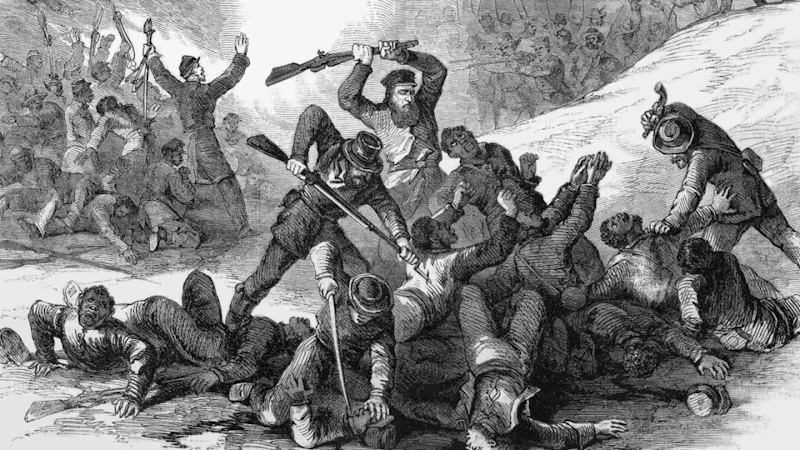
Forrest and his officers ran among the men, loudly ordering them to cease fire, and the killing finally stopped. The fight was over, the Federals having had 350 of their 557 shot, with 221 killed outright. The black troops suffered most of those killed and wounded, with only 58 of the 262 blacks troops there being taken prisoner. Forrest had suffered 100 casualties, with only 14 killed. Forrest gathered up his loot and prisoners that night and pulled out, sending back one of his officers along with a captured Union captain to flag down a gunboat and have badly wounded Federals picked up for evacuation to Memphis.
* Chalmers had been busy in the meantime, detaching a few companies to make the Federals nervous at Columbus, then sweeping into Paducah at noon on 14 April to snatch the horses missed on the earlier raid. He was back in Tennessee the next day to link up with the main force.
Forrest had returned to Jackson, Tennessee on the 14th, where he received a message from Lieutenant General Polk, ordering him to return to Okolona, Mississippi, to help deal with a Federal cavalry raid that Polk's intelligence indicated was now being prepared in middle Tennessee. Forrest replied that he would obey the order, though his own observations suggested that no such operation was being planned by the Federals.
Indeed, the observations Forrest made while on the raid were entirely astute. He had already written Joe Johnston on 6 April: "I am of the opinion that everything is being concentrated against General Lee and yourself." Johnston was astute himself, and that no doubt confirmed his worst fears -- but Forrest added that if Johnston could combine his own cavalry resources with Forrest's, the rebels could raid through central Tennessee and cut the logistical foundation out from underneath Federal operations in the region.
Forrest repeated this assertion in a letter to Jefferson Davis written on 15 April, stating that "a move could be made into Middle Tennessee and Kentucky which would create a diversion of the enemy's resources and enable us to break up his plans." It was a daring plan, and clearly risky; Brigadier General John Hunt Morgan had attempted a similar raid in July 1863, penetrating into Ohio -- the raid having come to ruin, with Morgan and much of his command captured. To reassure Davis that this wasn't another half-baked scheme like the one that landed Morgan in an Ohio prison, Forrest added that "such an expedition, managed with prudence and executed with rapidity, can be safely made."
Having made his recommendations to the authorities, Forrest then tied up loose ends before his return to northern Mississippi, putting his loot in order and finishing up his recruiting drive in West Tennessee. Not all of the recruits were voluntary. Forrest, indifferent to the fact that Tennessee was in Yankee hands, enforced Confederate conscription laws, and every able-bodied male between the age of 17 and 45 that his patrols found was immediately drafted into the Confederate States Army, without even being given the opportunity to go home and pack. Such an approach was somehow not surprising coming from a man who had traded in slaves. Whatever the methods, Forrest returned from his raid stronger than when he had left.
* He also left behind an uproar like none other that had followed his raids. He always stirred up a hornet's nest, but the action at Fort Pillow, bad enough in itself, was being escalated by the rumor mill and the Union newspapers into an organized and pre-planned massacre of men, women, and children, with some of the victims burned or buried alive. Indeed, the "Fort Pillow Massacre" became the atrocity tale of the war.
A subcommittee of the iron-fisted Congressional Joint Committee on the Conduct of the War left Washington DC on 20 April, arriving in west Tennessee on the 23rd. They interviewed survivors and "eyewitnesses" who told ghastly stories, which were dutifully distilled into a lurid report that inflamed public opinion even more. The report was denounced by Southern newspapers, for once more or less accurately, as "a tissue of lies from beginning to end." Lincoln had already told Secretary of War Stanton on 17 April to investigate what he referred to with a lawyer's caution as "the alleged butchery of our troops", and Stanton passed the issue on to Grant. Grant immediately wired Sherman to investigate, saying:
   IF OUR MEN HAVE BEEN MURDERED
   AFTER CAPTURE, RETALIATION MUST
   BE RESORTED TO PROMPTLY.
Sherman investigated, and in his findings he made no such recommendation, concluding essentially that to the extent excesses had taken place at Fort Pillow, such things happen in war. Since Sherman's attitude toward Forrest could hardly be described as sympathetic -- it was more along the line of wishing the Wizard of the Saddle could be sent straight to Hell as soon as possible -- his judgement on the matter was seen as credible.
That didn't mean that the incident had no effects, since on 17 April Grant halted prisoner exchanges. Informal prisoner exchanges had taken place early in the war, but the Lincoln Administration was reluctant to do anything that implied political recognition of the Confederacy, and so it wasn't until July 1862 that formal "cartel" for prisoner exchanges was established. However, the agreement began to falter in the fall of 1863, and now it had been shut down indefinitely. Partly this was in response to the fact that rebel soldiers had shown a strong inclination to shoot black men in Union blue who tried to surrender, as demonstrated at Fort Pillow. The Lincoln Administration considered executing Confederate prisoners in return -- but that would be mad, attempted to match the brutality of an adversary with one's own, and obviously would lead to reprisals in turn on Yankee prisoners in rebel hands.
More officially, Confederate authorities had made it clear that if black Union soldiers who had been slaves were taken prisoner, they would be returned to slavery and would not be subject to prisoner exchanges. Black soldiers who had been freedmen would be exchanged, but a Confederate exchange commissioner explained that the Confederacy "had a right to send slaves back to slavery as stolen property recaptured." The Emancipation Proclamation had formally established the principle of taking away Southern slaves as a direct blow to the rebel effort; it was too much to swallow to exchange "property" that had been stolen from Southerners in the first place, and worse put in uniform with arms to fight the South.
Secretary of War Stanton and Ben Butler had been wrangling with the Confederates over this issue for months, but the Confederates were unyielding in their refusal to treat black Union soldiers as legitimate prisoners of war. Grant was also angry because Confederate troops that had been captured and paroled had been sent back into combat without the exchange of Union prisoners. He declared in direct terms that the South would have to agree to exchange Union prisoners without regard to skin color, and also agree to live up to their side of the bargain on paroles.
No agreement was forthcoming, and so Grant could do nothing but suspend the prisoner exchanges. Grant was perfectly aware that suspending the exchanges served the North's strategic interests -- no, the contraband argument didn't really cut both ways. Since the South had a substantially smaller population than the North, a head-for-head prisoner exchange was effectively giving the Confederacy an advantage. There was also a general belief in the North that Southern prisoners in Northern prison camps were well-treated and likely to be able to return to battle after being exchanged, while Northern prisoners returned from Southern camps would be too starved and ill to go back to duty -- though the reality was that Northern prison camps were almost as bad as Southern prison camps.
The breakdown in prisoner exchanges made matters more miserable for both sides, but the Confederates got the worse part of the deal. Some have claimed that Grant was being cynically callous when he stopped the exchanges, but he made it clear that prisoner exchanges would be resumed if the Confederacy agreed to treat Union prisoners even-handedly, regardless of skin color. If Southerners insisted on working against their own best interests, Grant could only shrug.
Still, although the argument still sputters on over which side was being more pigheaded while prisoners suffered and died, the fact of the matter is that agreements between bitter adversaries are likely to be troublesome, and the odds of such arrangements breaking down are very high. Prisoner exchanges are unusual in modern days; they are a concept of polite warfare, a notion that had been popular at the outset of the fighting, but by the spring of 1864, neither side had much faith in polite warfare any longer.
BACK_TO_TOP* All through the winter months at the beginning of 1864, Joe Johnston plagued Richmond for more troops, more supplies, more everything. Johnston did not take daring risks like Robert E. Lee. Johnston had about 45,000 men, including two corps of 20,000 and 5,000 cavalry under Major General Joe Wheeler; knew that a Union force about twice the size of his own was being assembled in Chattanooga, and was intimidated.
Johnston's caution infuriated Richmond, where the belief, or at least the desperate hope, was that he was to take the offensive; but it endeared Johnston to his men. He loved his troops and they adored him in return, calling him "Old Joe". Unfortunately, that didn't apply to his generals, who had learned bickering ways under Braxton Bragg, if they hadn't known them before, and kept up their squabbling after Bragg's departure. Johnston told a friend: "If I were president, I'd distribute the generals of the army over the Confederacy."
There were exceptions; Johnston assigned command of his two corps to generals he regarded highly. Hardee was plain, solid and reliable, and John Bell Hood -- who had been in Richmond, recovering from serious wounds obtained at the Battle of Chickamauga -- was a champion fighter, even though he was half-crippled from the injuries of war. Johnston did not know that Hood was spying on him: before returning from Richmond, Hood had been ordered to send back reports in secret. Johnston's defensive-mindedness did not sit well with a fighter like Hood. Hood's reports said again and again: "The enemy is weak and we are strong." That was exactly what Richmond wanted to hear, and nobody asked Hood exactly what intelligence he had that supported such optimism.
Richmond also knew that Grant was preparing to move against Lee in northern Virginia, and Confederate leadership didn't think that the Yankees would conduct two major war campaigns at once. Given the immense logistics required for such efforts, there was some reasonable basis for this belief, but in hindsight it seems to have been just wishful thinking: The Union had never coordinated their efforts before, and it would be so inconvenient of them to learn from past mistakes and change their ways.
* Johnston had his own streak of wishful thinking, though it was not so far removed from reality as Richmond's. He knew that the enlistment terms of many of Sherman's veterans would be up in the spring, and believed many were so sick of the war that they wouldn't re-enlist. He was wrong. The Federals, down to the average infantryman, rightfully felt they now had the upper hand, and the prospect of final victory was a strong motive to stay in the fight.
The Union troops were confident in their leader, who they called "Uncle Billy", and he was confident in himself. He was lean and wiry and gawky and scruffy, dressed plain and unpretentious, and lived like they did in the field. He was a bundle of nervous energy, always talking rapidly, "boiling over with ideas", as another officer put it, "crammed full of feeling, discussing every subject and pronouncing on it all." He was particularly hyperactive at the moment, sleeping only a few hours a night, running back and forth to make sure everything was in place, fidgeting endlessly, occasionally making absent-minded fumbles -- lighting a cigar, then tossing away the cigar and walking off with the match, oblivious to his error and to people laughing at him.
The distance between Chattanooga and Atlanta, Sherman's target, was only about a hundred miles (160 kilometers) as the crow flies. Unfortunately, only a crow would find it a particularly straightforward trip, since the country was lined with ridges that presented substantial barriers to an invader. Joe Johnston was a skilled defensive fighter, and so Sherman had to assume that the rebels would make the best use of the terrain to slow down the offensive.
On the plus side, Sherman had an excellent supply line between those two points, in the form of Western & Atlantic Railroad. To be sure, the Confederates would tear up the line as they withdrew and rebel cavalry would continuously try to cut it behind the rear of the Yankee advance, but Sherman had factored such matters into his plans. The Civil War has been called "the first railroad war", and Sherman understood the importance of the railroad to the extent that he made its operation another part of military drill. Repair crews were thoroughly trained to work fast and well, and stockpiles of rails, ties, and whatever else might be needed to keep the trains rolling were set up. Blockhouses were also set up near tunnels and bridges to deter raiders, while sidings were built at regular intervals to make sure that traffic kept flowing. There was a telegraph station at each siding to provide alerts in case of attacks or accidents.
Sherman issued strict rules ensuring that the trains were reserved to carry supplies -- banning their use by troops returning from furloughs and by civilians. The ban on civilian traffic included reporters. Sherman regarded that as a bonus, since it conveniently got rid of the "dirty newspaper scribblers" that he despised. The bans even eliminated food shipments to loyalists in east Tennessee. When President Lincoln tried to intervene, Sherman explained the necessity and concluded bluntly: "I will not change my order."
However, Sherman had not reckoned on Mary Ann Bickerdyke, a hardnosed widow from Illinois who had taken it on herself to organize nursing activities for the western armies, and affectionately known as "Mother" by the troops. When Mother Bickerdyke found her medical supplies blocked, she refused to accept it, went to Sherman's headquarters, pushed her way past all obstacles, confronted him, and single-mindedly refused to take NO for an answer. Sherman finally signed an order authorizing the shipment of her supplies. When some of Sherman's officers later complained about the pushy Mother Bickerdyke, he threw up his hands and replied: "She outranks me. I can't do a thing in the world."
* Sherman took other drastic measures to ensure that the rail lines from Chattanooga to Louisville, Kentucky -- his main supply base on the Ohio River -- and Nashville -- which had been set up as an alternate supply base -- remained open and efficient. He had built up such extensive stockpiles of everything in Nashville that one of the brigadiers on his staff described the city simply as "one vast storehouse". Such was the economic and industrial power of the Union. Sherman had been deadly accurate when he said to a Southerner in the days when the war was approaching: "The North can make a steam engine, locomotive, or railway car; hardly a yard of cloth of pair of shoes can you make."
Sherman, however, would not sit idly until he felt all things were in place. His troops would travel lightly on limited supplies and move fast. Sherman himself would maintain a minimal headquarters, with only a single wagon to carry supplies, and the only place he had to stash his official papers was in his pockets -- though he would eventually compromise and find a box for them. If the quartermasters couldn't keep up, so be it, Sherman telling one of them: "And if you don't have my army supplied, and keep it supplied, we'll eat your mules up, sir; eat your mules up!" Eating mules seemed hardly necessary, though. Sherman wrote Grant: "Georgia has millions of inhabitants. If they can live, we should not starve."
Despite his confidence, Sherman didn't think the campaign would be a walk-through. The Confederates were not softening in the least: "No amount of poverty or adversity seems to shake their faith. Niggers gone, wealth and luxury gone, money worthless, starvation in view ... yet I see no sign of let up -- some few deserters, plenty tired of war, but the masses determined to fight it out." He wrote his wife: "All that has gone before is mere skirmishing."
BACK_TO_TOP* By the beginning of May, Sherman was ready to go. His "Military Division of the Mississippi" had 110,000 men, formed into three armies:
Sherman began his offensive on 4 May 1864. Johnston had set up his defenses in front of Dalton, Georgia, 30 miles (48 kilometers) south of Chattanooga. Dalton was shielded to the west by Rocky Face Ridge, a particularly jagged and intimidating piece of north Georgia ridgework.
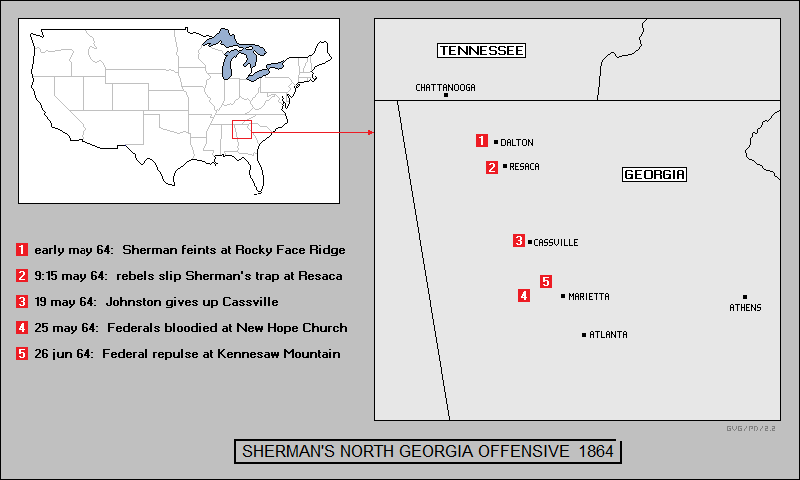
The main avenue of advance through Rocky Face Ridge was at Buzzard Roost, a few miles north of Dalton, where the Confederates were heavily dug in. The position was strong to begin with, and the defenses had been skillfully laid out. The rebels had even built dams to create an artificial lake as an obstruction. Sherman, inclined to the dramatic, called the position the "terrible door of death". There was another opening in the ridge at Dug Gap, a few miles south of Dalton, that was every bit as formidable.
Sherman didn't like the odds of forcing either of those passes. However, Sherman believed he saw an opportunity at Resaca, a small town on the rail line to Atlanta, about 13 miles (21 kilometers) south of Dalton. There was a long, shallow valley named Snake Creek Gap that ran through the mountains straight towards Resaca through which troops could advance.
Johnston was too good a general to ignore such an obvious vulnerability -- but due to some mixup in communications, Snake Creek Gap was all but unguarded. Sherman decided to have Thomas demonstrate against Rocky Face Ridge from the west, have Schofield to threaten from the north beyond the eastern slope of the ridge, while McPherson moved quickly through Snake Creek Gap to Resaca. This would give the Federals a grip around Joe Johnston's lifeline. At the very least, Johnston would have to retreat out of his strong position, while at best, the entire Confederate Army of the Tennessee would be swallowed up and forced to surrender.
Pap Thomas had originally come up with the plan in February, suggesting that he and his corps be entrusted with the flanking movement. Although Thomas' force was the most powerful of the three Sherman had at his disposal, Sherman believed McPherson would move faster. McPherson was an excellent and bold officer, but Sherman's orders to McPherson were vague and did not stress the need for a determined attack.
Thomas and his army made solid contact with the Confederates on 6 May at Tunnel Hill, to the northwest of Buzzard Roost, where the rebels had set up a fortified position around a railroad tunnel. Thomas hit them hard the next day, 7 May, and drove the Confederates back to their main line. The rebels pulled out in such a hurry that they failed to destroy the tunnel.
Thomas began his "demonstrations" against Buzzard Roost on 8 May and continued them on 9 May. As expected, he made little progress, though some Federals did manage to make it to the top of the ridge before being pushed back by counterattacks. Apparently inspired by Johnston's leadership, the rebels were not the cowed creatures they had been at Missionary Ridge. This was emphasized that same day, 9 May, when Schofield's cavalry got too far ahead of the main body and fell into a trap set by Wheeler. The Federal troopers took 150 casualties and were driven from the field.
Sherman was unconcerned, since the only real goal of both Thomas and Schofield was to keep the Confederates occupied, and indeed Thomas' men were doing better than Sherman expected. The important thing was what McPherson did. On the evening of 9 May, Sherman received a message from McPherson stating that the Union Army of the Tennessee was through Snake Creek Gap, having encountered little resistance, and only a few miles outside of Resaca. Sherman was ecstatic, banging on his dinner table and crying out: "I've got Joe Johnston dead!"
* Sherman's joy was premature. Federal intelligence was faulty; the Confederates were holding Resaca in strength.
Grant's original grand strategy for the West envisioned a move against Mobile to pin down Confederate forces in the region, but Nathaniel Banks was now occupied elsewhere, freeing those forces to come to Johnston's aid. On 1 May, as the Federals were preparing to begin their offensive, Joe Johnston had wired Richmond asking for help from Polk's forces in Demopolis, Alabama, requesting a division if it could be obtained. Bragg promptly wired Polk to send a division. Jefferson Davis followed up with a telegram asking Polk to send along more forces if possible, and to supervise the move in person.
Polk was agreeable, he and Johnston being on good terms, having been cadets together at West Point decades before. Polk had three infantry divisions and a cavalry division, a total of 19,000 men, and decided to take them all except for 2,000 men, left behind under the command of Major General Stephen Lee, Polk's chief of cavalry.
In the advance of Polk's reinforcements was a brigade of 2,000 men from Mobile, Alabama, under Brigadier General James Cantey. They arrived in Rome, Georgia, at the southern end of the battle theater, on 5 May and moved into Resaca on 7 May, their force increased by 2,000 men of Johnston's command.
McPherson moved on Resaca on the afternoon of 9 May, only to find the approaches to the town solidly defended. His force of 25,000 could have probably overwhelmed the 4,000 defenders, but he hadn't expected any resistance. Although not normally timid, McPherson knew that being in the rear of the enemy meant the Confederates could easily cut him off, and there was only an hour of daylight left anyway. Sherman's orders gave him a generally free hand to do what he thought right. McPherson pulled back to Snake Creek Gap that evening, to dig in, ask for instructions from Sherman, and wait for a reply.
That same evening, Johnston was informed of McPherson's probe on Resaca -- leading to an exercise in confusion. Johnston told Hood to take one of his divisions and two of Hardee's down to Resaca to brace the defense. Hood did so, but the next day, 10 May, he reported McPherson's lack of aggressiveness to Johnston. Johnston decided the Federal presence before Resaca was just a feint, and ordered Hood to move back north.
In the meantime, Hardee was puzzled because Thomas had generally given up his attacks, and decided the Yankees were up to something. Johnston came to the same conclusion. He began to wonder if the Federal move through Snake Creek Gap might not actually be a feint.
Polk had arrived in Rome on 10 May with his lead division, so forces were now becoming available to resist a Union push from that direction. To dispel his confusion, on 11 May Johnston ordered Polk to move his divisions to Resaca, then ordered Joe Wheeler to take his cavalry and find out what the Yankees were up to at Snake Creek Gap. Johnston also wired Richmond to suggest that Bedford Forrest make a raid in middle Tennessee to cut Sherman's supply lines. With all the Federals on the move in North Georgia, Forrest would not have to worry about tangling with any major Union force.
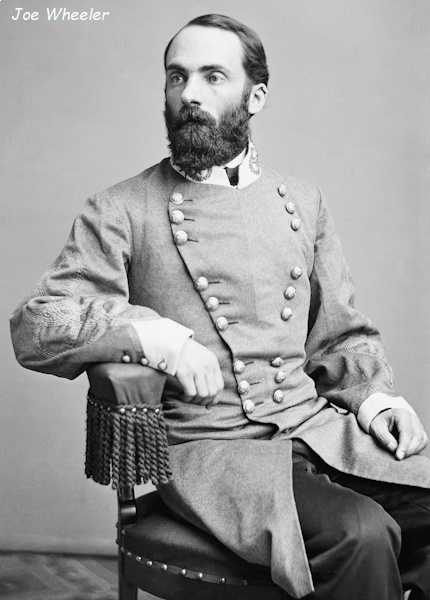
Wheeler reported back that afternoon that the Federals were in fact shifting their forces south, confirming Johnston's fears. That evening, Polk showed up at headquarters, and Johnston greeted him warmly: "How can I thank you? I asked for a division, but you have come yourself and brought your army."
Polk then went to Hood's tent, where the bishop baptized Hood. Having lost a leg in combat, Hood could not kneel and had to stand on crutches for the ceremony. Polk returned to Resaca late that night. The next morning, 12 May, Johnston decided to pull out of Dalton. He had already been shifting his forces towards Resaca so they would be in a position to move against a Federal push on the southern end of his line, and shifting the rest was straightforward.
The Confederates pulled out of Dalton and the northern line on Rocky Face Ridge that night, and when the sun came up on Friday the 13th, the Yankees facing that line suddenly realized there was nobody there. As a Federal put it, Johnston had pulled off another of his "clean retreats".
Sherman was appalled, "much vexed" as one of his staff put it. However, he had to admit that McPherson was justified in his conduct by the fuzzy orders he had received -- though when they met later, he cut McPherson with the remark: "Well, Mac, you missed the opportunity of your life."
* There was nothing for Sherman to do but advance on Resaca now. Shifting his forces through the rugged terrain was difficult, and the fighting didn't start until the evening of 13 May, kicking off with a cavalry duel between rebel cavalry under Joe Wheeler and Union cavalry under Judson Kilpatrick, who now reported to Sherman. The clash was insignificant, though Kilpatrick was wounded and put out of action for a few weeks.
On 14 May, Sherman threw his men at Resaca, to no useful result. Johnston was there in force, the defenses were skillfully laid out, and there was no moving the rebels. Indeed, late in the day Hood threw his troops back at the Federals in a devastating counterthrust, though Federal guns firing canister and the fall of night blunted the attack.
Johnston was very pleased with the results of the day's battle and wanted Hood to try again in the morning, but that night Johnston received intelligence that made him very nervous. McPherson had scored one of the only Yankee successes that day, seizing without a fight high ground that overlooked the southern end of the Confederate defense. Now Johnston learned that McPherson had set up artillery on that high ground, allowing the Yankees to drop shells on the bridges over the Oostanaula River, to the south of the rebel position. That threatened Johnston's line of retreat, and he ordered that a pontoon bridge be set up out of range of the Federal guns.
Worse, Johnston then received reports that a substantial force of Yankees were crossing the Oostanaula to the south, within reach of his lifeline, the Western & Atlantic railroad. Johnston ordered Hardee to send a division under Major General W.H.T. Walker on a night march to block the incursion, and rearranged his dispositions around Resaca so that his army could pull out quickly if need be.
Sherman's troops attacked again on the morning of 15 May, making no more progress than the day before. Around noon, Johnston received word from Walker that the reports of Yankees downstream were untrue, and so Johnston decided to have Hood perform a second counterthrust that afternoon. A rebel battery went forward to support the assault. As it turned out, they went too far forward, since the Federals hit them so hard that the Confederates had to abandon all four of their guns. Most of the gunners were killed. One had the bad judgement to have marked FORT PILLOW on his uniform: the Yankees didn't even try to take him prisoner, instead shooting him and bayoneting him repeatedly, as if they couldn't make him dead enough.
Hood was ready to go ahead with the attack anyway, but then got orders from Johnston telling him to stand down. Walker had sent a second report to Johnston stating that the first was in error, the Yankees actually were present in strength.
The conflicting reports sent to Johnston about Yankee activities in the area were actually true and accurate. Sherman had sent Kilpatrick's cavalry division, without its wounded commander, south to a place named Lay's Ferry on 14 May to set up a pontoon bridge, and had followed it up on the 15th by sending one of McPherson's infantry divisions, under Brigadier General Thomas Sweeny, a profane one-armed Irishman, to back up the cavalry. Sweeny's division had probed across the river and come back the day before, which had led to the conflicting reports to Johnston that the Yankees were making trouble there.
In parallel with the move of Sweeny and his men, Sherman also sent one of Pap Thomas' cavalry divisions, under Brigadier General Kenner Garrard, on a much longer probe over 20 miles (32 kilometers) to the south, to attack the town of Rome. If Garrard was able to seize Rome, he was then to proceed due east and capture Kingston, on the Western & Atlantic, cutting Johnston's line of retreat.
Johnston was unaware of Garrard's force, but Kilpatrick and Sweeny's troops were a clear threat in themselves. Johnston decided to withdraw, and set up a meeting that night to give his corps commanders orders for the withdrawal. The Confederates pulled out of Resaca during the night, using a pavement of cornstalks to muffle the sounds of horses and wagons, while pickets kept up a racket with aimless rifle fire. The next morning, 16 May, the entrenchments around the town were empty. The rebels had taken everything with them, except for the four pieces captured the previous afternoon, much to the embarrassment of Hood.
BACK_TO_TOP* Sherman pursued Johnston, and also dispatched a second cavalry division under Brigadier General Jefferson C. Davis from Thomas' force to follow up Garrard's probe at Rome. Sherman was frustrated at not being able to come to grips with Johnston's army, but he was at least satisfied that the Confederates were falling back.
Sherman organized his force into three columns. Thomas's hard-hitting army advanced directly down the Western & Atlantic towards Kingston, while McPherson took his troops on a parallel route to the west, and Schofield marched his men on a parallel route to the east. That allowed Sherman to threaten the Confederates with flanking moves from the west or east if they decided to make a stand, and also prevented a single road from being clogged with his entire army. To balance his forces, he transferred three divisions under Major General Joseph Hooker from Thomas's command to Schofield's, leaving Thomas with about 40,000 men and giving Schofield about 30,000.
Everyone in Sherman's army was excited. They had pushed Johnston out of formidable defenses at a cost of about only 4,000 men to themselves, and the rebels seemed to be on the run. The Federals were kept well-fed and well-supplied by streams of trains, running down tracks that were rebuilt by Sherman's repair gangs with amazing speed. The telegraph lines were restored with equal efficiency.
On 18 May, Garrard and Davis occupied Rome. The city had important factories and an iron works, but even more significantly taking the town cut the main line of communication between Johnston and Confederate forces to the west. If Johnston was to get any more reinforcements from that direction -- not that many were left after Polk had joined his ranks -- they would have to come by roundabout routes.
While Thomas's army moved south along the Western & Atlantic, his soldiers had running skirmishes with troops of Hardee's corps in the rearguard of Johnston's army. However, the rebels did little to slow down the march, and by the morning of 19 May, all three of Sherman's columns were converging on Kingston, where Sherman thought Johnston intended to make a stand.
* Sherman was wrong. Johnston was too canny to sit idly and wait to be trapped by a superior force; he had shifted his other two corps under Polk and Hood to Cassville, five miles (eight kilometers) to the east, in hopes of springing an ambush. Hardee's "rearguard" action was actually nothing of the sort: he was disconnected from Johnston's force, and stringing the Yankees along towards Kingston, encouraging them to believe that they were really hot on the trail of the entire Confederate Army of the Tennessee.
Johnston had been looking for the opportunity for a counterthrust for the last several days, encouraged by news from the west that Forrest would begin his hoped-for raid into middle Tennessee within a few days. The landscape that Johnston had been marching through after his withdrawal from Resaca was open and not well suited to defense, but he correctly decided that Sherman would split up his forces.
Cassville looked like it had possibilities. From there, Johnston could fall on Schofield's army and chew it up badly before help could arrive -- then, if he moved quickly, he could attack the other two columns in turn and maul them as well. If Forrest also managed to cut the Yankee supply lines, Sherman would be forced to withdraw, and Johnston would have handed the Union a major defeat. Everything was in preparation for springing the trap on the morning of 19 May, and the rebels were confident and excited. One soldier wrote later: "We were going to whip and rout the Yankees."
In his secret messages to Richmond, Hood had been incessantly sniping at Johnston's lack of aggressiveness -- but now that he had been let off the leash, Hood suddenly turned timid, advancing only about a mile and then digging in, saying that the Yankees were in a position to fall on his flanks and cut him off. In reality, the only Federals in the area were members of a small cavalry detachment that had become separated from the main line of march. Johnston was forced to pull back to a ridge south of Cassville, where Hardee and his corps linked up with the rest of the army.
The assault didn't come off. Schofield quickly discovered there were two Confederate corps threatening him. However, Johnston found the position his troops had fallen back to was very strong, dominated by a tall, steep, long ridge. Sherman was obviously feeling aggressive, and with luck the Federals might perform a rash attack on rebel defenses that would result in a lopsided Union defeat. By the evening of 19 May, the guns of the two sides were firing shots at each other in an obvious prelude to a major Federal assault come the dawn; Johnston was looking forward to it. The only problem was that Hood and Polk were not and went to him that night, insisting that a further retreat was necessary to save the army. Johnston didn't believe it. He consulted with Hardee, who didn't believe it either.
Johnston could not hope for success if two of his three corps commanders had such a defeatist attitude; he ordered another withdrawal, undoubtedly sympathizing with Braxton Bragg's troubles. One of Johnston's staff officers wrote in his diary about Hood: "One lieutenant general talks about attack and not giving ground, publicly, and quietly urges retreat." After the war the fiasco at Cassville would figure prominently in a running feud between Johnston and Hood, with Hood insisting that he had actually pushed for an assault.
* The Confederates shifted south about another ten miles (16 kilometers), below the Etowah River, and set up on 20 May at Allatoona Pass, where the Western & Atlantic cut through a gash in yet another jagged ridge. Although Johnston normally conducted his retreats with great efficiency, this one was characterized by confusion and traffic jams, compounded by the demoralization of his troops in seeing their hopes of a great victory turn into yet another retreat.
The new rebel position was very strong -- in fact too strong, so obviously formidable that nobody in their senses would try to attack it directly. Sherman was thoroughly familiar with the area. Two decades earlier, as a young Army lieutenant, he had been stationed at Marietta, Georgia, about 20 miles (32 kilometers) to the southeast, and now Johnston's forward base of supplies on the Western & Atlantic. Sherman had spent his free time exploring the area, commenting after the war that he knew more about Georgia than the enemy did, and knew just what a trap Allatoona Pass would be.
That meant another flanking movement, a long one this time. Now Sherman would take his entire grand army on an arc towards Dallas, Georgia, 20 miles (32 kilometers) to the southwest of Allatoona Pass. The movement would be difficult, since the area was heavily wooded and had few roads, but Sherman still felt that he could get the jump on Joe Johnston.
Sherman took three days off before putting his troops in motion again, allowing the men to rest and refit while work gangs got the Western & Atlantic in operation. The movement began on 23 May. Unfortunately, the next day Schofield's troops captured a Confederate dispatch rider whose messages revealed that the Federal move had been immediately detected, and the rebel defense was being correspondingly rearranged. Wheeler had tipped off Johnston on 24 May, and Johnston had immediately shifted his troops to the southwest to counter the move. Surprising Johnston was not easy; Sherman later referred to Johnston's "lynx-eyed watchfulness". Sherman became more cautious, lest he fall into a trap like that which Schofield had narrowly evaded at Cassville.
* The line of Federal march arced across Pumpkin Vine Creek, which flowed northeast towards the Etowah River. On 25 May Joe Hooker's corps of three divisions returned to Thomas's army and, in the lead, approached the creek, where they ran into rebel cavalry who tried to burn the bridges. The Confederates were driven off and the fires put out.
The Federals crossed the creek and advanced into the woods beyond the eastern bank. Near New Hope Church, a Methodist establishment in the woods a few miles northeast of Dallas, Hooker's men ran into a substantial force of Confederate infantry. Hooker attacked them with his lead division, under Brigadier General John Geary.
Hooker thought he was catching some element of Johnston's army on the march. What he was dealing with instead was Hood's full corps, which had just positioned itself on the northern end of Johnston's new line of defense and was digging in. Polk's corps was similarly digging in just south of Hood's, with Hardee's moving in to hold down the southern end of the line.
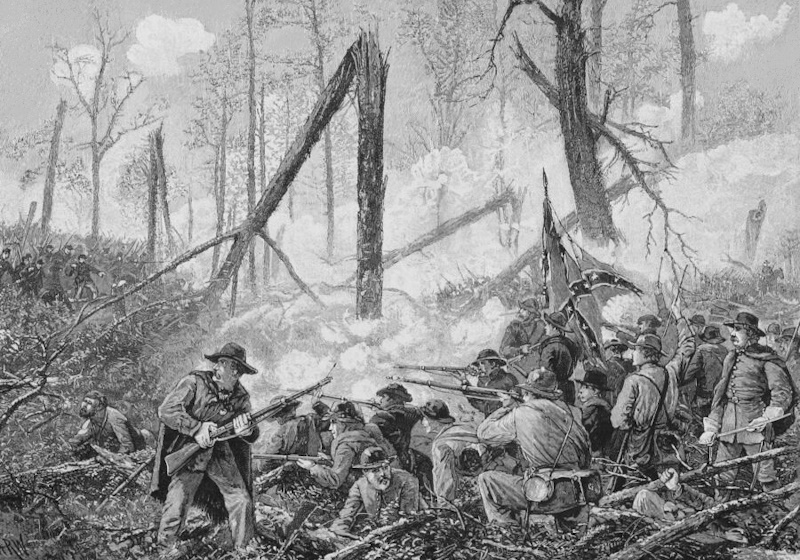
Geary's division collided with Hood's men and was promptly knocked back hard. Hooker was in good form that day; although he was beginning to suspect that he was up against a formidable rebel force, he threw all three of his divisions at the Confederates. The Federal assault focused on the middle of Hood's line, held by a division under Major General Alexander P. Stewart. Hooker's troops hit as hard as they could, but Stewart's men held, assisted by well-sited guns that inflicted terrible casualties on the close-packed Yankees. Stewart reported later: "No more persistent attack or determined resistance was anywhere made."
The fight near New Hope Church went on for three hours. A violent thunderstorm began before sundown and began to dampen the bloodshed, though one Union soldier, caught up in the excitement, said he still wanted to "swim over and tackle the Johnnies." Darkness finally put a complete halt to the shooting. Hooker reported his losses at 1,665 -- though since Hooker was prone to under-report his casualties, that may have been an underestimate. The rebels lost about half that many men, since they had been fighting from a reasonably strong position.
BACK_TO_TOP