
* General Sherman persevered in his offensive through north Georgia hill country, leading to battles at Pickett's Mill, and then a particularly big fight at Kennesaw Mountain. Progress was slow and expensive, but Sherman could afford the losses. In the meantime, Confederate cavalryman John Hunt Morgan conducted a poorly-planned raid into Kentucky, resulting in the scattering of his command, with Morgan fleeing to evade capture.

* Sherman's troops continued to move up to the line during the night, which was damp, dark, muddy, and filled with swearing Union men stumbling through the undergrowth. Schofield was knocked off his horse when he wandered into a branch, to be laid up for several days.
When the sun came up, Sherman found his own forces neatly stalemated by a strong line of rebel defenses. Sherman probed Johnston's defense all the next day, the 26th, and into the morning of 27 May. Finding no weaknesses, at mid-morning Sherman ordered a flanking movement around the northern end of the line at a place named Pickett's Mill, a few miles northeast of New Hope Church.
The assault was made by Major General Oliver Howard's corps of three divisions, part of Thomas's army. Howard's men moved out in the early afternoon, with Brigadier General Thomas Wood's division in the lead. The Union troops struggled through the brush for several hours and didn't make contact with the rebels until about 4:30 PM. Unfortunately for Howard, Johnston had second-guessed that Sherman would try this stunt, and had ordered Hardee to send one of divisions to the north of Hood's line. Hardee put in Major General Patrick Cleburne's division, and there were no rebel troops better trained or more aggressively led than Cleburne's. Cleburne, an Irish immigrant with a background in the British Army, was one of the most outstanding officers of the Confederate Army, greatly admired by both his men and by his superiors.
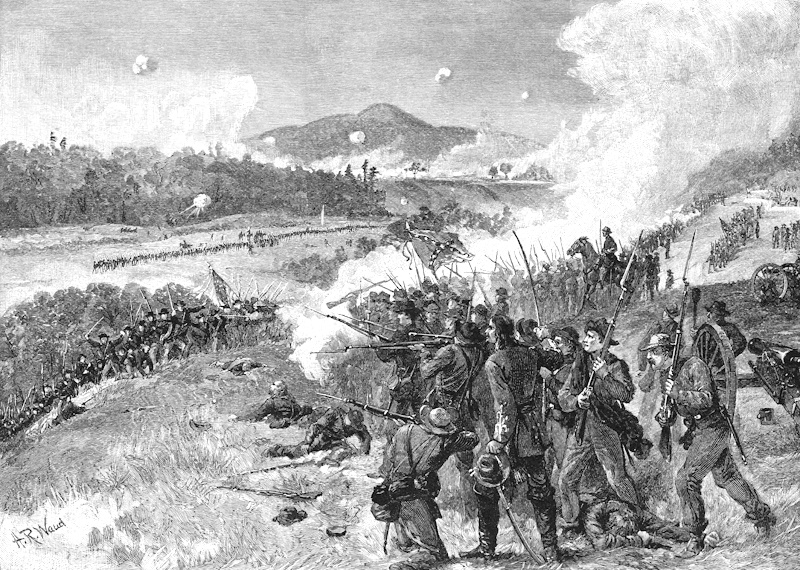
Wood's division stumbled up against the fresh Confederate breastworks and was promptly blown apart by the massed, accurate fire of Cleburne's men. The assault was stopped cold, and Howard was forced to call on reinforcements not merely from Thomas's army but from Schofield's simply to hold off disaster. The fighting went on for three hours, dying down at nightfall, though at 10:00 PM Cleburne sent out a brigade of Texans in a daring and highly successful night attack that swept over a group of Federal troops trying to find safety in a ravine, adding to the Union casualty list. At the end of it, Wood's division alone had suffered 1,457 casualties, while Cleburne reported the loss of 448 men.
* Johnston reasoned that if Sherman was pushing on the northern end of the Confederate line, then he had probably pulled troops from the southern end of the Union line for the attack. Johnston ordered Hardee to probe Federal defenses around Dallas to see if that was the case, and the next morning Hardee sent out a division under Major General William Bate. Johnston's reasoning was plausible, but incorrect. Bate's division was thrown back by McPherson's troops, the rebels losing about 400 men, the Federals about half that many. In such terrain, the Yankees were every bit as immovable on the defense as the Confederates.
At a council of war that day, Hood proposed that he shift his corps eastward to perform a flanking attack on the northern end of the Federal line, with his assault to be followed up in sequence by drives from Polk's and Hardee's corps all along the line. Johnston liked the plan; he gave orders scheduling it for the next morning, 29 May, with Polk and Hardee to jump off when they heard the thunder of Hood's artillery.
The sun came up, nothing happened, hours passed, and then orders came down from Johnston calling off the attack. Hood had reported that a division of Yankees had appeared and were blocking his line of attack in well-prepared defenses. Once again, Hood had talked tough and not followed through. However, for once he was being prudent: previous clashes in the area had clearly proven that the defender had the advantage in the wooded terrain, and both sides had long since learned how to build almost impregnable fortifications in a matter of hours.
The Yankees liked to say: "The rebels must carry their breastworks with them!" -- while the Confederates returned the compliment, saying: "Sherman's men march with a rifle in one hand and a spade in the other!" Now both sides dug in whenever they had the chance, and they had turned the area into a mazework of trenches and redoubts. Some estimated that there were 400 to 500 miles (640 to 800 kilometers) of trenchworks in the area. A few of the Union generals thought their men were losing their edge, but Schofield was casual about it, suggesting that a soldier's attitude toward combat was much the same as his attitude toward farming or running a sawmill: "He wants to see a fair prospect that it is going to pay."
Still, for the moment the two armies were stalemated. The fighting through May had cost Sherman about 9,300 men, with Johnston's losses numbering about 8,500. Sherman's losses were tolerable -- he was far more able to absorb them than Johnston -- and the Federals had pushed the Confederates from Dalton to Dallas. Despite these satisfactions, Sherman knew that he had accomplished nothing decisive as long as Johnston's army survived.
On 1 June, two of Sherman's mounted divisions, one under Brigadier General Kenner Garrard, the other under Major General George Stoneman, seized Allatoona Pass from the small Confederate force that Joe Johnston had left there. That meant that Federal locomotives would now be able to steam south to provide Sherman's grand army with food, powder, and bullets.
* Sherman's attempt to outflank the Confederates at Dallas, Georgia, had clearly failed. He had hoped to move decisively, but the fighting had instantly degraded into what he called "a big Indian war". His men would afterwards remember the area as the "Hell Hole". Sherman decided it was time for another shift. He also wanted to get his offensive astride the Western & Atlantic Railroad again to simplify his supply problems.
Getting the troops on the move again proved difficult, since on 1 June it also began to rain. The rains kept up for over two weeks, turning the landscape into a red clay quagmire, infested with mosquitoes and chiggers. The fact that the Federals weren't moving very fast under such conditions didn't make Joe Johnston complacent, however: realizing that the fall of Allatoona Pass had rendered his current position impractical, on 4 June he pulled off another clean retreat.
Sherman was not happy at this turn of events. Johnston's instincts for the defense were excellent, and his new position was as or more formidable as any he had occupied during the campaign. The line was anchored in the northeast, beyond the Western & Atlantic, on Brush Mountain, where Hood had set up his corps. The center was sited at Pine Mountain, on the near side of the railroad, which was occupied by Polk's corps. The southwest end of the line was anchored by Lost Mountain, held down by Hardee's corps. Johnston had a backup position available at Kennesaw Mountain, shielding Johnson's supply base at Marietta, the defense being sited about two miles (3.2 kilometers) southeast of Pine Mountain.
By 6 June, the Federals had advanced up to the Confederate line, with McPherson facing Hood, Thomas facing Polk, and Schofield facing Hardee. There was no real action for the moment, the Federals spending their time refitting for further action. On 9 June, Major General Francis P. Blair JR, having completed a temporary stint in Congress, returned to McPherson's command, bringing along 10,000 men who had been on reenlistment furloughs. These reinforcements made good Sherman's losses in the campaign. On 11 June, repair crews finally managed to get the Western & Atlantic working all the way down to Big Shanty, where McPherson's army was situated. The trains could now bring in fresh provisions, which were welcomed by the troops who had been subsisting on bacon, hardtack, and coffee during their side trip through the Georgia wilderness.
The troops might have been happy; Sherman was not. Although Hood was sniping at Johnston's timidity to Richmond, Sherman found Johnston very skilled at slowing the Federals down and making them pay in blood. Sherman was particularly unhappy to find that after the vicious fighting around Dallas his soldiers had become timid, advancing slowly and digging in at the first sign of enemy resistance. Dancing around with Joe Johnston didn't seem to be getting Sherman anywhere, but simply driving headlong into rebel defenses didn't seem to be much of a plan either. The Federals kept up the pressure, and in response Johnston contracted his defenses into the center, making them just that much harder to crack.
* After the contraction, Pine Mountain was held only a brigade of infantry and two batteries of guns, one commanded by Lieutenant Rene Beauregard, the son of Confederate General Pierre Toutant Beauregard. Pine Mountain was hardly more than a hill, but it still had a good view of the countryside and was an asset to the rebel defense.
Hardee worried that the Federals might be able to seize the hill and the rebels occupying it with a surprise attack, and on 14 June Johnston and Hardee rode over to consider the matter. Polk came along to scout out the countryside. Johnston concluded that Hardee's judgement was correct and that the position should be abandoned. While Johnston was there, however, he decided to take in the view from the top of the hill, even though the Federals had been firing on anything that moved on Pine Mountain with accurate, long-range Parrott rifled guns.
Sherman was inspecting the front at the time and saw the Confederates accumulating on the top of Pine Mountain, though he was too far away to make out who they were. He was annoyed at their boldness, complaining: "How saucy they are!" He ordered Oliver Howard, in charge of this section of the line, to have a battery fire on them to "make them take cover". The order filtered down to Battery I of the First Ohio Light Artillery. The battery's commander, Captain Hubert Dilger, was already shooting at the rebels when the order reached him.
Dilger was an artillerist on leave from the Prussian Army. He had signed up with the Union in 1861 and seen action in many of the major battles back East, arriving in the West with Major General Joseph Hooker's corps, which had been transferred from the East to help with the breakout from Chattanooga. He was well-known all through Sherman's army, partly because of the distinctive and highly non-regulation way he dressed, wearing a clean white shirt with rolled-up sleeves; shiny high boots; and doeskin trousers, which led to him being nicknamed "Leatherbreeches". He was also very professional and aggressive, moving his guns up so close to the fighting line that one joker suggested they should be fitted with bayonets. Since he spoke English with a strong German accent that was hard to understand in the thick of fighting, he had developed a system of hand claps to communicate with his men.
Dilger ordered one of his gunners to "just tickle them fellers" and clapped his hands. The first shot missed the cluster of Confederate officers, but Johnston, knowing the Federals would quickly get the range, ordered everyone to disperse and take cover. A second shot landed closer. Johnston and Hardee got behind the hill in haste, but Polk, who was cool under fire, walked off as though on a thoughtful stroll through the woods. A third shot came ripping up to the top of the hill and tore through him from side to side. It was messy but quick. Polk was 58 years old.
Johnston and Hardee ran back in a panic to Polk's mangled body. Both of the generals wept, Johnston saying: "We have lost much." Then he added: "I would rather have anything but this." He later commented that the killing was the result of Polk's "characteristic insensibility to danger." A message was sent by signal flag for an ambulance to cart off Polk's corpse.
Braxton Bragg, who had often clashed with Polk, might not have been too unhappy at the news, but most of Johnston's army mourned. Polk hadn't been the most brilliant of generals, but he had fought courageously in many of the major battles of the West from Shiloh on, his troops generally admired him, and -- being an Episcopal bishop as well as a general -- he had lent moral stature to the cause. The Federals spotted the signal flags asking for an ambulance to haul off Polk's corpse. Sherman found the news invigorating, relieving the irritability he had felt for the previous two weeks, and he wired Halleck with satisfaction on 15 June:
   WE KILLED BISHOP POLK YESTERDAY
   AND MADE GOOD PROGRESS TODAY.
Still, for the rest of his life, Sherman was careful to deny the story that he himself had lined up the shot that had sent Polk to a better world.
Johnston evacuated Pine Mountain as planned. When the Federals got there, they found scrawled in chalk on the door of a cabin:
   YOU DAMNED YANKEES
   YOU HAVE KILLED OUR
   OLD GENERAL POLK.
* Pine Mountain gave the Yankees a fingerhold into the Confederate defense. Sherman began to consider forcing Johnston's line, wiring Halleck on 16 June:
   I AM NOW INCLINED TO FEIGN ON
   BOTH FLANKS AND ASSAULT THE
   CENTER.  IT MAY COST US DEAR,
   BUT IN RESULTS WOULD SURPASS
   ANY ATTEMPT TO PASS AROUND.
Sherman thought it might work because Johnston's line was overextended. Johnston, sharp as ever, thought the same thing, and on the night of 17 June he pulled his forces back to Kennesaw Mountain, leaving the Federals staring at empty trenches in the morning.
If the Federals were impressed with Johnston's ability to slip away at exactly the right time, rebel troops were equally impressed with Sherman's habit of circling around obstacles and forcing them to withdraw. One Confederate who was taken prisoner told his captors: "Sherman'll never go to Hell. He will flank the devil and go to Heaven in spite of the guards."
However, for the moment Sherman was blocked. Kennesaw Mountain was a tall double peak, isolated from the other mountains in the area. The Western & Atlantic snaked around its northeast flank. It was a very strong and extremely intimidating defensive position. The weather continued to be wet, making a rapid flanking move impossible.
Command of the late General Polk's corps had been handed to Major General William W. Loring, the senior division commander. Loring's corps had dug into the face of the mountain, with batteries posted high up where they could command the approaches. Hood's corps had been moved to cover the railroad on the northeast edge of the mountain, while Hardee's corps protected the southwest edge.
Johnston had not occupied any stronger position during the entire north Georgia campaign. Sherman didn't want to smash his army on such a rock, so he kept up pressure with artillery bombardments while he launched probing attacks to see if he could find a way around. Schofield, reinforced by Hooker's corps, prodded around the southwest, while McPherson felt his way around the northeast. In the center, Thomas pounded away continuously with 130 guns. Union soldiers watching the bombardment decided that Uncle Billy was either going to take the mountain, or fill it full of iron.
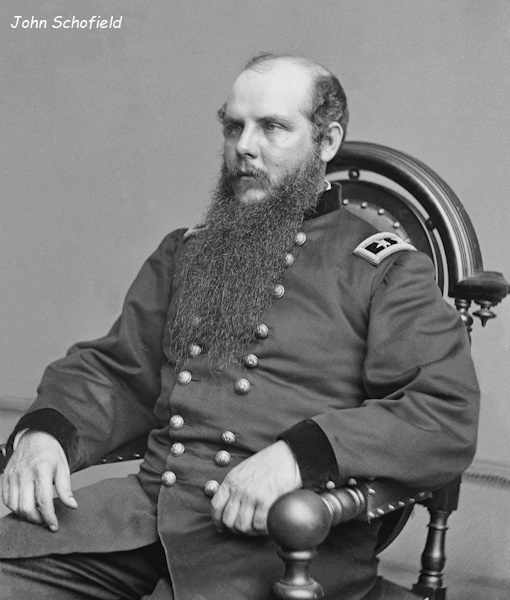
Schofield seemed to be making progress, and so late on 21 June Johnston ordered Hood to take his corps at sunup across the back of the mountain to reinforce Hardee. Wheeler's cavalry would hold the trenches vacated by Hood's men. Hood arrived late in the morning of 22 June with his men and, as always aggressive, decided to attack Schofield immediately. Hood didn't even bother to inform Johnston of this decision, nor did he try to scout out the terrain or determine just how many Federals were in front of him. There were actually about 14,000 Yankees to 11,000 rebels. Even if Hood had known the odds, he was such an enthusiast for the offensive that he would have probably gone ahead anyway.
The assault began at midday. The Federals faded back quickly and Hood, smelling blood, pursued. In reality, Schofield and Hooker had been expecting such a stunt, and their troops were simply falling back toward entrenchments in their rear around a place named Culp's Farm. On making contact with these defenses, Hood found them heavily braced by artillery throwing out shot, shell, and canister at a fast rate. The "rout" of the Federals immediately turned into a bloody repulse of the pursuing rebels.
The Confederates rallied and tried again, with precisely the same results. As darkness fell, the broken ranks of Confederates fell back to the safety of their own lines, while the Yankees jeered at them and dared them to try it again. Hood lost about a thousand men, the Yankees less than a third that many. Hood tried to conceal the extent of his defeat to Johnston, which would also be fuel for later quarrels between the two generals.
Johnston was displeased with Hood's impetuosity. However, Sherman wasn't happy either; Hooker's troops had borne the brunt of the attack, and Hooker had become excited, sending back dispatches saying he had driven off two attacks by three Confederate corps while crying for reinforcements. Sherman knew that Johnston only had a total of three corps, and that the lines in front of the other Union forces were still occupied.
Sherman didn't like Hooker much -- most other Union generals who knew Hooker didn't like him either -- and what Sherman might have ignored from another general, was a cause for fault with Hooker. The next morning Sherman rode over in a downpour to meet Hooker, and told him in essence to cut the crap, giving Hooker no credit for what amounted to a tidy Union victory. Sherman wrote later of Hooker, as if it could have been any surprise: "From that time he began to sulk."
BACK_TO_TOP* Sherman was also unhappy because Johnston had decisively blocked any further probes by Schofield and Hooker in that direction. Sherman was now at a loss for what to do to break the stalemate. He finally decided to try to force Johnston's line with a frontal attack, using the forces of Thomas and McPherson.
Nobody was enthusiastic about the idea, and Sherman himself knew it was a big gamble. He wired Halleck on 23 June:
   THE WHOLE COUNTRY IS ONE VAST FORT.
   JOHNSTON MUST HAVE FIFTY MILES OF
   CONNECTED ENTRENCHMENTS, WITH ABATIS
   AND FINISHED BATTERIES ... OUR LINES
   ARE NOW IN CLOSE CONTACT AND THE
   FIGHTING INCESSANT, WITH A GOOD DEAL
   OF ARTILLERY.  AS FAST AS WE GAIN
   ONE POSITION, THE ENEMY HAS ANOTHER
   ALL READY.
Sherman reasoned that Johnston's reshuffling of his forces to meet the Federal probes around his flanks meant that the defenses in the center of the line were lightly held, and the fact that they looked so intimidating might lull the Confederates into thinking the Yankees would never attack them, providing an element of surprise. These were more in the nature of plausible ideas than solid calculations, but Sherman had been growing frustrated with what he saw as the increasing timidity of his troops, which the perceptive Johnston would be certain to exploit sooner rather than later. The Union newspapers, which annoyed Sherman at the best of times, had also been making noises about his lack of aggressiveness.
The attack might have seemed suicidal, but Thomas' men had chased Bragg and his army off Missionary Ridge seven months ago, and that had seemed like a suicidal assault to those watching it. It might work again. Thomas, McPherson, and Schofield reluctantly agreed to the plan. Sherman sent out an order to his senior officers on 24 June to conduct reconnaissance and prepare for an assault at 8:00 AM on 26 June.
Sherman was hedging his bet. He would commit only a fifth of his troops. If the rebel defenses were vulnerable to a quick push, that would be enough to do the job; if not, no sense in wrecking all of his army. He also planned to precede the assault with a heavy, hour-long artillery bombardment.
McPherson's army would attack the southwest corner of Kennesaw Mountain itself, where Loring's corps was dug in. Thomas would assault the hopefully vulnerable rebel lines just to the south, driving against Hardee's corps. Hooker and Schofield would feint at the far southern end of the rebel defenses, held by Hood and his corps. Sherman hoped that the simultaneous assault all along the Confederate line would prevent Johnston from deciding which part of his defenses were most at risk until it was too late.
Union security was good, and very few of the men knew what was in store for them as their officers made preparations. The Federals probed and scouted rebel defenses, letting the troops on both sides know something was going to happen, but they didn't have a clear idea of what.
* The rain let up on Sunday, 26 June, and the sun came up bright and hot. At exactly 8:00 AM, massed Federal guns started pounding Confederate lines in an intense bombardment. One rebel shouted out over the noise: "Hell has broke loose in Georgia, sure enough!" However, they were deeply dug in, and even in later wars using much more effective artillery, attackers would find it difficult to destroy well-prepared fortifications with barrages alone.
At 9:00 AM, the guns mostly fell silent, and Union infantry rose up out of their own earthworks to move swiftly towards rebel lines. The Federals advanced unmolested at first, until they moved into the open and into range of Confederate rifles. Then the line in front of the advancing troops erupted into fire. McPherson had sent forward 4,000 of his men, but they never got closer than a stone's throw of the rebel defenses, with hundreds shot down. The attack was quickly broken, with the survivors pinned down to the ground.
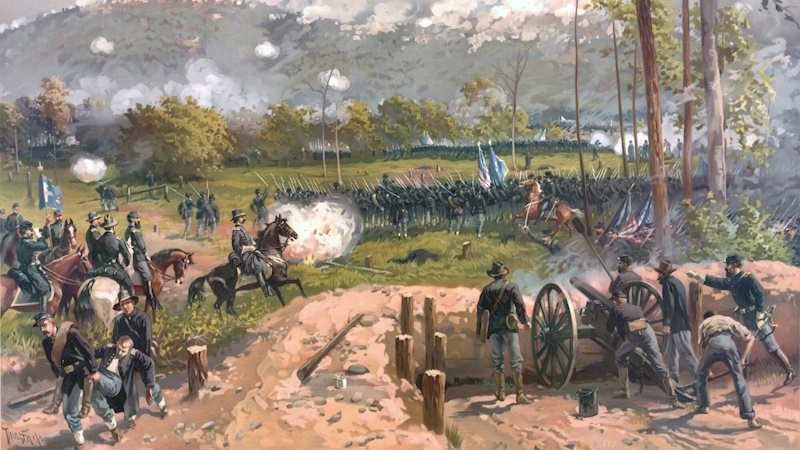
Thomas had committed almost twice as many men, and they pressed their assault more resolutely, though it bought them nothing. One rebel commented: "They seemed to walk up and take death as coolly as if they were automatic or wooden men."
Two brigades under Jefferson C. Davis went forward against a salient in the rebel lines, with the Confederates under the command of Major General Benjamin Cheatham. The attack was pressed very hard, but to no good result, one Federal writing that the rebel defenses were like "veritable volcanoes, belching forth fire and smoke." The survivors fell back and scraped up such cover as they could, in hopes of surviving until night could allow them to creep out of range. In the meantime, as another Yankee later put it: "It was almost sure death to take your face out of the dust." The Federals would later remember that section of the rebel line as the "Dead Angle".
Elsewhere on the line, one of Thomas's brigades was badly cut up in front of trenches held by two Arkansas regiments, leaving behind many wounded as the attack faded back. The fighting started a brush fire that swept towards the wounded men. The Confederate commander, Lieutenant Colonel William H. Martin, could not stomach the idea of watching the soldiers being burned alive, so he stood up, waving a flag of truce, and shouted to the Union men: "COME AND REMOVE YOUR WOUNDED! THEY ARE BURNING TO DEATH! WE WON'T FIRE A GUN UNTIL YOU GET THEM AWAY! BE QUICK!" They were, and Confederates even got out of the trenches to help the Yankees haul off the injured men. In appreciation, one Union major gave Martin a pair of Colt revolvers. Then the two sides went back to killing each other.
By mid-morning, the futility of the effort was obvious, and the commanders in the line sent back word to Thomas that there was no hope of taking the enemy's positions. Thomas replied at 11:00 AM, telling the men to dig in where they were and wait for darkness to withdraw.
The Battle of Kennesaw Mountain was effectively over, the Federals losing about 3,000 men to about a sixth as many Confederates. Sherman wired Thomas in the early afternoon, asking if Thomas thought another push was advisable. Thomas prudently replied:
   WE HAVE ALREADY LOST HEAVILY TODAY
   WITHOUT GAINING ANY MATERIAL ADVANTAGE.
   ONE OR TWO MORE SUCH ASSAULTS WOULD
   USE UP THIS ARMY.
Sherman's assessment that his men had become timid proved entirely unjust, with Johnston commenting with admiration on their courage and tenacity when it was obvious that they had no chance of success. Oliver Howard summed it up simply: "We realized now, as never before, the futility of direct assault upon entrenched lines already well prepared and well manned." The Southern press crowed about the bloodying of the Yankees, predicting that Sherman and his army were "whipped" and would soon be "cut to pieces".
An armistice was declared on 30 June to allow burial of the dead, who were rotting quickly in the hot Georgia summer heat. They were dragged into mass graves with hooks made from bayonets, with strict orders that nothing was to be taken from the bodies. Some Confederates helped, and there was a little fraternizing between the two sides, with trades of coffee and tobacco. Although officers tended to frown on fraternization, Cheatham took part in it -- to find himself surrounded by Federal soldiers who wanted his autograph, his unyielding defense of the Dead Angle having greatly impressed the Yankees.
Sherman rationalized his actions to Halleck, saying that the assault had certainly told Johnston that he could not rely too heavily on his entrenchments and assume the Yankees would never test their strength. Sherman told Thomas: "Our loss is small compared with some of those in the East. It should not in the least discourage us. At times, assaults are necessary and inevitable."
Indeed, although the Battle of Kennesaw Mountain had raised the total Federal casualties for the North Georgia campaign to about 17,000, well above the Confederate total of 14,000, Sherman's casualties were only about a seventh of his army, while Johnston had lost a good quarter of his men. Given that the number of casualties in an army on the offense would be expected to be higher than those of an army on the defense, the overall ratio of casualties was in the Union's favor. Sherman's army had certainly taken a whipping, but it was just as certainly not close to being cut to pieces.
Sherman was bland about the whole thing. He wrote his wife: "I begin to regard the death and mangling of a couple of thousand men as a small affair, a kind of morning dash. It may be well that we become hardened ... The worst of the war is yet to come."
BACK_TO_TOP* Sherman's offensive into northern Georgia was heavily dependent on his railroad lifeline through middle Tennessee, and its security was never far from his mind. In mid-June he had written his wife: "Thus far we have been well supplied, and I hope it will continue, though I expect to hear every day of Forrest breaking into Tennessee from some quarter. John Morgan is in Kentucky, but I attach little importance to him or his raid. Forrest is a more dangerous man."
John Hunt Morgan was in fact in Kentucky, his home state. He and his senior officers had been locked up in the Ohio state penitentiary after his disastrous raid in July, but they had managed to dig their way out and make their way to Confederate lines. His failed raid had greatly damaged his credibility, and he ended up in the backwaters of western Virginia.
Morgan wasn't happy with being sidelined. When he received intelligence that the Union commander of the District of Kentucky, Brigadier General Stephen Burbridge, was assembling a force for a drive into Virginia, Morgan decided that the best way to disrupt Burbridge's plans was to hit first. He decided to take his troopers into Kentucky to disrupt Union plans; he didn't bother to get authorization, simply informing Richmond of his plans, and departed at the end of May.
Morgan reached the town of Mount Sterling in Kentucky bluegrass country on the morning of 8 June, announcing his presence with the capture of a garrison of about 380 Yankees and their valuable supplies. He was at the head of about 2,700 men, about a third of them new recruits without mounts or gear. Morgan intended to obtain the necessary horses, weapons, and equipment from the Federals -- but many of the recruits had more independent ideas of how to get what they needed. After all, any healthy man of secessionist sympathies who wasn't in the Confederate States Army at that late date was more likely than not mere trash; there was a general spree of looting and strongarm robbery at Mount Sterling, with some of the harder cases even pulling their pistols on women to take their jewelry. At one time many Kentuckians had welcomed Confederate raiders, but the rebels had now worn their welcome out.
Morgan and his officers tried to stop the robberies, but it was hopeless. He was particularly appalled when a group of townspeople approached him to complain that one of his colonels had given them an order to hand over $72,000 in gold and bills from a local bank, with the order indicating that the town would be torched if the demand wasn't met. The colonel in question was present, and the order was quickly determined to be a forgery. The description of the person who had used the order to take the money matched that of a German surgeon named Goode, who had prudently vanished. He was later rumored to be living well back in Germany.
However embarrassing that was to Morgan, he was deep in Union territory on a raid and had no time to sort things out. He mounted up the men who had horses and led them off towards Lexington, Kentucky, only 30 miles (48 kilometers) away, leaving behind 800 men lacking mounts to dispose of the Federal stores the raiders had captured.
Things were going wrong for Morgan, and they wouldn't get better. His calculation that a raid into Kentucky would force Burbridge to give up his march towards Virginia did prove correct; what Morgan had not figured on was the lethal speed with which Burbridge reacted. Burbridge's men fell on Mount Sterling at dawn on 9 June, shooting or capturing about 350 of the 800 rebels there. Some of the defenders, hung over from their entertainments the day before, were shot before they could even get out of bed.
Morgan was on the road to Lexington when he got the bad news. He considered turning around and taking Burbridge on but, on realizing that the Union force of about 5,000 outnumbered his own, thought the better of it. He took his mounted men and those who had managed to escape from Mount Sterling on towards Lexington, camped on the outskirts of the city, and rode in on the morning of 10 June.
The rebels captured a large stockpile of supplies and enough horses to ensure that Morgan's entire force was properly mounted -- while his men also helped themselves to whatever they could rob from the townspeople. This time even some of his old-time veterans joined in, encouraged by the example of the newcomers. The local papers reported: "Though the stay of Morgan's command in Lexington was brief, embracing but a few hours, he made good use of his time -- as many empty shelves and pockets will testify." The raiders robbed another bank, this time using revolvers instead of a forged note, and made off with $10,000.
That afternoon, after learning that there was a garrison of 500 Yankees and a stockpile of stores in Cynthiana, about 30 miles (48 kilometers) to the southeast, he put his men on the road again. Some were so drunk they had to be thrown into wagons to sleep it off. Morgan arrived in Cynthiana the next morning, 11 June, and demanded the garrison's surrender. The Federals refused, with a nasty house-to-house fight following in which Morgan's men ended up burning down most of the town. The Yankees finally gave up, but then Morgan's lookouts reported a Union column approaching.
It was 1,200 Federals under Burbridge's lieutenant, Brigadier General Edward Hobson. Morgan's force, which greatly outnumbered Hobson's, quickly encircled the Federals and forced them to surrender as well. That was a great satisfaction to Morgan, since Hobson had captured about half of Morgan's command during the raid above the Ohio the year before.
Morgan did not hang on to his winnings for long. That evening, his scouts informed him that Burbridge was moving up with his column. Between losses and sending out detachments, Morgan only had about 1,400 men to Burbridge's 5,000, but Morgan, encouraged by the day's successes, felt confident, telling his officers that he would fight Burbridge in the morning. There were protests that Burbridge was too strong and that ammunition was running low. The rebels had captured a large amount of ammunition, but it was for Yankee Springfield rifles and would not fit their British Enfield rifles. Morgan told one of the officers: "It is my order that you hold your position at all hazard. We can whip him with empty guns." It is unlikely that those who had doubts as to Morgan's wisdom were much reassured by this declaration, but it is certainly likely it convinced them that they might as well stop complaining and shut up.
Burbridge attacked at dawn on 12 June. Morgan's men held out stubbornly until they ran out of ammunition, and then the defense collapsed. One of the Confederates reported later: "Our whole command was forced back into the streets of the town, routed and demoralized. The confusion was indescribable ... There was much shooting, swearing, and yelling. Some from sheer mortification were crying." Morgan tried to organize an orderly withdrawal but his command was disintegrating, and soon it was everyone for themselves. Many were shot down or captured by the Yankees. Morgan evaded capture and managed to make it back to Virginia before June was out, but he had lost half his men.
He tried to put a good face on things, reporting that he had disrupted Burbridge's plans and destroyed large quantities of Federal supplies, but his superiors were unimpressed. Union newspapers made much of the bad behavior of Morgan's men and gloated over the thorough whipping dished out to the raiders -- which was all the harder for Richmond to swallow because the expedition hadn't been authorized in the first place. It was Morgan's last big gamble, and he had lost badly.
BACK_TO_TOP