
* Sherman's offensive into north Georgia continued to be threatened by Bedford Forrest and his raiders, and so Sherman dispatched a force into northern Mississippi to deal with Forrest. Unfortunately, Forrest was too much for them, giving them a thrashing at Brice's Crossroads and sending them in flight. Sherman still continued his movement southward, until he was in sight of his objective, Atlanta -- when he got the welcome news that Joe Johnston had been replaced in command by John Bell Hood, a more aggressive but less competent general. Sherman also sent another expedition into northern Mississippi that enjoyed much more success than the previous -- though, to Sherman's disgust, it failed to take Bedford Forrest off the playing board. all.

* John Hunt Morgan's bungled raid into Kentucky ended up hurting the Confederacy more than the Union, and did little to interfere with the Federal war effort. Sherman knew better than to expect Forrest to be so inept, and had taken measures to deal with him and his raiders. After the Fort Pillow incident, Sherman replaced the commander of the District of West Tennessee, Major General Stephen Hurlbut, with Major General Cadwallader C. Washburn -- brother of Grant's political guardian angel, Illinois Congressman Elihu B. Washburn. General Washburn had proven aggressive during the Vicksburg campaign the year before, and Sherman believed he would do a better job than Hurlbut in dealing with Forrest.
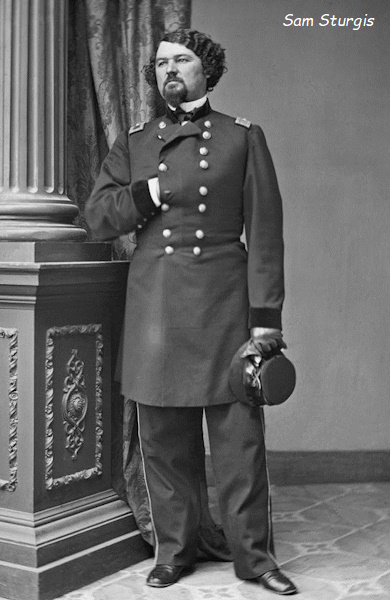
Sherman also appointed Brigadier General Samuel D. Sturgis as Washburn's chief of cavalry. Sturgis had been in many battles in both West and East and was regarded as aggressive, having energetically pursued Forrest into northern Mississippi during the last Confederate raid into West Tennessee in April, only giving up when supplies ran out.
At the beginning of the northern Georgia campaign, Sherman instructed Washburn to organize an expedition into northern Mississippi under the command of Sturgis to at least distract and hopefully destroy Forrest and his command. Washburn took two weeks to organize the effort. He provided Sturgis with a force of 8,300 men, consisting of a division of infantry under Colonel William L. McMillen, and a division of cavalry under Brigadier General Benjamin Grierson, who had led a famous raid through Mississippi during the Vicksburg campaign. The force was equipped with 22 guns and 250 wagons with provisions for 20 days, and Grierson's troopers had the latest repeating rifles. One of McMillen's three brigades was composed of black soldiers, who were burning for revenge for the Fort Pillow massacre.
Sturgis's force set out from Collierville on 1 June, but the next day they ran into the rains that were making Sherman's men miserable in Georgia, slowing movement to a crawl. On 8 June, the column reached Ripley, Mississippi, where Sturgis had given up his pursuit of Forrest back in April.
Sturgis was discouraged by the slogging through the mud, feeling that with each day of delay the rebels were becoming stronger and more dangerous. He had already dispatched a detachment of cavalry to cut the Mobile & Ohio railroad at Rienzi, just south of Corinth, to hinder the movements of enemy troops. Sturgis considered turning back, but McMillen suggested it would be a humiliation to go back to Memphis without having met the enemy. Sturgis wavered, and finally decided to press on. Sturgis needn't have worried about facing overwhelming rebel forces, since Polk had gone east with the bulk of his troops; in fact, Sturgis outnumbered the rebels in front of him by about two to one. The only problem was that the rebels had Forrest, who rarely missed any tricks.
* Sherman's belief that Forrest was about to fall on his railroad lifeline was perfectly accurate, since Forrest had left Tupelo, Mississippi, on 1 June with 2,200 cavalrymen and six guns on precisely such a raid. However, Forrest had only got as far as northern Alabama when a message from the department commander, Major General Stephen Lee, caught up with him on 3 June, informing him of the Federal incursion and ordering him to return immediately.
Forrest was back in Tupelo on 5 June, where he conferred with Lee. The M&O railroad ran north to south through potential Federal targets: Corinth, Rienzi, Rucker, Baldwin, Guntown, and then Tupelo. Lee indicated that Forrest should move to a location between Corinth and Tupelo in order to meet possible motions of the Federals, drawing them into the state to lengthen their supply lines before taking them on. Lee wisely gave Forrest plenty of discretion to do as he thought best, while Lee scraped up more troops.
Forrest had 4,300 men available to him in three brigades. The largest was Colonel Tyree Bell's brigade, with 2,800 men, while the other two brigades, under Colonels Hylan Lyon and Edmund Rucker, had about 750 men each. Bell and his brigade were sent to Rienzi, where they drove off the detachment that Sturgis had dispatched to cut the M&O. The other two brigades went to Boonville, accompanied by two four-gun batteries under Captain John Morton, which was all the artillery Forrest had available to him.
When Sturgis arrived in Ripley on 8 June, Forrest finally had a precise idea of where the Federals were and where they were going. A single ten-mile (16-kilometer) road connected Ripley to Guntown on the M&O; it was called the "Wire Road", because a telegraph line had once run along it. If the Yankees were going to advance, it would have to be along the Wire Road.
Forrest received 500 more men that day, part of a brigade under the command of William A. Johnson, bringing the total force available to fight Sturgis to 4,800 men. Forrest was still entirely outnumbered but he knew the area well, having grown up in Ripley, and judged that the terrain would help negate the numerical advantage of the Federals.
Sturgis moved out of Ripley on the Wire Road on 9 June, halting that evening about halfway to Guntown at a farm owned by a man named Stubbs. Forrest then sent out orders for his forces to converge on the Wire Road ahead of the current Federal position, with the assault focusing on the area around an intersection named Brice's Crossroads. The Confederates moved out in the dark hours of the morning. Forrest rode in the advance with a personal escort company and Lyon's brigade. Colonel Rucker rode with them, his brigade following.
As the sun rose on 10 June, Forrest explained his thinking to Rucker: "I know they greatly outnumber the troops I have on hand, but the road along which they will march is narrow and muddy; they will make slow progress. The country is densely wooded, and the undergrowth so heavy, that when we strike them they will not know how few men we have."
The roads were muddy for the rebels as well, and they would have to move quickly over long distances to achieve their convergence. Forrest had considered that, too: "Their cavalry will move out ahead of their infantry, and should reach the crossroads three hours in advance. As soon as the fight opens they will send back to have the infantry hurried in. It is going to be as hot as hell, and coming on the run for five or six miles, their infantry will be so tired out that we will ride right over them." He concluded by telling Rucker: "I want everything to move up as soon as possible. I will go ahead with Lyon and the escort and open the fight."
* Sturgis had in fact sent Grierson's cavalry on ahead that morning, giving the infantry a little additional time in camp to dry out their clothes. At about 10:00 AM, a rider came back from Grierson stating his troopers were under heavy attack and that help was needed.
Sturgis decided to ride up the road to see what was going on, after giving orders for McMillen to step up his march. Sturgis found the wagon train following the cavalry snarled and bogged down in mud and flooded-out bottom land; he arrived at Brice's Crossroads about noon to find a confused fight in progress. Some of Grierson's brigade commanders were completely discouraged and wanted to skedaddle, but Grierson himself was confident, telling Sturgis that his troopers had already driven off three charges by the Confederates, inflicting severe losses on them in the process. Grierson wasn't sure how much longer he could hold out under the circumstances, however. Sturgis sent back orders to McMillen to tell him to move up as rapidly as possible.
In fact, the confusion was entirely one-sided. All three of the "charges" that Grierson had "driven off" were noisy feints, with such of Forrest's troops as had managed to get to the fight rushing forward in a great show and then fading back immediately on contact. Forrest wasn't going to really attack until he thought the time was right, and the only severe losses Grierson were inflicting was on his ammunition supply. He was all but out of ammunition at about 01:00 PM, when McMillen arrived with his lead brigade to find, as he put it later, "everything going to the devil as fast as it possibly could." Grierson and his cavalry retired from the field while McMillen moved up his other two brigades as fast as possible. It was truly "hot as hell" that day, with men collapsing on the march in the burning Mississippi sun, the rest arriving on the field exhausted.
All of Forrest's men had now come up. There was a short lull in the fighting while he arranged an attack, a real one this time. He told the men with him: "Get up, men. I have ordered Bell to charge on the left. When you hear the guns, and you hear the bugle, every man must charge, and we will give them hell." They hit the Federals hard, but however disorganized or winded the Yankees were, most of these troops were used to fighting -- and in fact one group performed a countercharge that threw back their attackers, almost breaking Forrest's assault. Forrest kept up the pressure, praising and threatening and cursing his men, and at about 4:00 PM he got them all to make one big, coordinated push that finally cracked the Union defense.
McMillen's men began to fade off the field of battle in a disorganized mob, creating a panic and a traffic jam on the narrow road. Forrest's troops kept up the "skeer", as he called it, following so closely that the Union troops could not organize an effective defense, or even burn their wagons. Forrest told the men in the lead to keep on going hard, not bothering to pick up prisoners. The Federals could be swept up by troops in the rear.
The chase went on into the night. Sturgis retreated back to Stubbs' farm, completely unstrung. At about midnight, Colonel Edward Bouton, the commander of McMillen's brigade of black soldiers, met with Sturgis. Bouton's troops had been guarding the wagon train during the fight, hadn't suffered as badly as the other two brigades, and still had fight in them. Bouton wanted to organize a defense, but Sturgis had no fight left in him. Bouton pleaded with him: "General, for God's sake, don't let us give up so!" Sturgis replied, numbly: "What can we do?"
Forrest gave his men a few hours to eat, tend to their mounts, and get a short rest, but had them on the road again in the dark hours of the morning. When the sun came up, they ran into a rear guard set up by the Federals just outside of Ripley, but the Confederates simply brushed it aside. The Yankees put up even less of a fight in Ripley itself, Forrest reporting later: "From this place, the enemy offered no organized resistance, but retreated in the most complete disorder, throwing away guns, clothing, and everything calculated to impede his flight."
The Federals fled so rapidly that Forrest, leading Bell and his brigade, wasn't fast enough to loop around and cut them off up the road. The Yankees escaped; that evening, 11 June, Forrest called off the chase to give his men some rest and a chance to pick prisoners and abandoned equipment. Sturgis and the survivors of the battle kept right on running, reaching Collierville on the morning of 12 June, the journey back proving much faster than the journey out. Fortunately for the Federals, the roads had dried. The soldiers were loaded onto a train that would take them back to Memphis. They were exhausted, many almost too sore to move, and had suffered a humiliation they would never forget.
Forrest had lost about 492 men killed and wounded -- not that much better than the 617 Yankees similarly shot down, and in fact worse relative to the smaller size of the rebel force -- but he had also collected more than 1,600 prisoners, not to mention 18 guns, 176 wagons, and large amounts of stores. Sturgis insisted that he had been heavily outnumbered, and a board of inquiry cleared him of accusations that he had been drunk. In fact, though the battle of Brice's Crossroads was another thorough Federal defeat, it had a shining silver lining: Sturgis had kept Forrest off of the Union supply line in central Tennessee. If the way in which it had been done was much less than satisfactory, it had still been done. That did Sturgis no good: he wouldn't be given a command again for the rest of the war. His men suspected that he had been drunk during the battle, or even was a traitor.
Forrest still remained a threat. Failing to defeat him in battle, Sherman ordered the Federal commander in North Alabama to burn to the ground any towns in that area that Forrest used as jumping-off points for raids into Tennessee. Sherman knew that such measures could hinder but not stop Forrest. The three divisions under A.J. Smith that Sherman had loaned out to Banks' Red River campaign were now returning, after the campaign had come to ruin.
Sherman had considered pulling them into his battle in north Georgia or sending them against Mobile, but now he decided to send them against Forrest. Sherman wrote Washington: "I will order them to make up a force and go out and follow Forrest to the death, if it costs 10,000 lives and breaks the Treasury. There will never be peace in Tennessee till Forrest is dead."
BACK_TO_TOP* Although Sherman's frontal attack on Johnston's Kennesaw Mountain line had failed, Schofield had managed to improve his position during the fight, giving the Federals an opening for a flanking move around the formidable Confederate line of defense. Sherman waited for the roads to dry out, and then moved out on 1 July. McPherson and Schofield's armies curved around the rebel defenses to the southeast, while Thomas and dismounted cavalry blocked any Confederate counterthrust.
Sherman didn't believe for a second that he would catch Joe Johnston napping, particularly because the rebels had a commanding view of the countryside from their eagle's roost on Kennesaw Mountain. Sherman ordered that scouts be sent out to check the Confederate line at sunrise on 3 July, and to nobody's surprise the scouts found the trenches empty. Sherman hoped he could catch the rebels on the march, where they would not be able to offset their inferior numbers with stout earthworks. He was in a great rush that morning, pushing his people to move as fast as possible. However, in mid-day he found out that Johnston had already taken refuge in pre-prepared defenses at Smyrna, five miles (eight kilometers) to the southeast. Sherman performed another flanking move; Johnston pulled out during the night.
The Chattahoochee River, the last major natural barrier in front of Atlanta, was about 6 miles (10 kilometers) to the south. Sherman believed that Johnston was too good a general to want to fight with a river to his back, and would probably take his men across to dig in along the south bank. That would give the Federals an opportunity to catch the rebels astride the river, but when Sherman got to the Chattahoochee on the morning of 5 July, he found the rebels snugly holed up in yet another preprepared line of defense, to his surprise set up on the north bank of the river.
It might have seemed unwise to set up such a seemingly trapped defense, but these were no ordinary fortifications. One Federal officer judged the Confederate works to be the most formidable the Yankees had encountered in the whole campaign, a neatly laid out deathtrap that protected six bridges spanning the river, allowing the rebels to skedaddle quickly if it came to that.
Johnston's wagons were parked south of the river, behind a secondary line of earthworks that could be quickly occupied as a fallback defense. His cavalry patrolled the south bank beyond the limits of the rebel line, making sure that any bridges that the Federals could use to cross the Chattahoochee were burned. Sherman's frustration with this development was mixed with admiration of his adversary. Sherman had a much higher opinion of Johnston than Johnston's own superiors did, writing later: "No officer or soldier who ever served under me will question the generalship of Joseph E. Johnston. His retreats were timely, in good order, and he left nothing behind." Johnston's superiors would have likely emphasized the use of the word "retreat".
Sherman did get a bit of satisfaction from his current situation. He and Thomas went to the top of a hill to see the lay of the land, and were rewarded with a view of the distant buildings of Atlanta, the goal of the whole campaign. The unexciteable Thomas showed no particular emotion at the sight, but Sherman was clearly exhilarated, "his eyes sparkling and his face aglow", as a witness said. One of Sherman's majors shared the emotion, writing home: "Mine eyes have beheld the promised land."
* Sherman was for the moment in no hurry to reach the promised land. His work crews needed some time to repair the railroad to the north and lay telegraph lines, and Johnston's defense was formidable enough to require some extended consideration anyway.
Clearly another flanking movement was required. Sherman ordered Thomas and McPherson to dig in before the rebel works to block a counterthrust. Schofield and his army were to stay in the rear and be ready to move quickly, while a cavalry division under Stoneman scouted downstream to the southwest and another cavalry division under Garrard went upstream to the northeast.
Stoneman found every bridge downstream burned and rebel cavalry watching him carefully. This expedition at least had the positive effect of distracting Johnston, who was less aware of Garrard's upstream expedition. Garrard also found that the Confederates had been thorough in burning the bridges upstream. His division rode as far upstream as the town of Roswell, where there were many factories that the Yankees promptly put to the torch.
Garrard's men found one textile factory that was flying the French tricolor. The factory owner, a Frenchman, claimed protection as a neutral, and the confused Garrard sent back a messenger to ask Sherman what should be done. Sherman lit up angrily, calling the Frenchman's claim "nonsense" and "perfidy", and gave Garrard authorization to hang the Frenchman. Garrard was not in a hanging mood, and let the Frenchman live; instead of burning the textile factory, however, Garrard tore it down and set his men to using the materials to rebuild the town's burned bridge.
While this effort was underway, Schofield and his army moved upriver as well, in search of a crossing. On 8 July, Schofield selected Soap Creek, about halfway between the northeast limit of the Confederate line and Roswell, as a promising site. There was rebel cavalry on the south bank, but they were not alert, strong in numbers, nor heavily armed, and Schofield planned the operation carefully. He moved up artillery and troops to the riverbank under the cover of the brush lining the river, then loaded up assault teams into 20 pontoon boats put into Soap Creek well up from its mouth. On a signal, the assault teams paddled down the creek as fast as they could while the troops and guns blasted away at the Confederates on the other side of the river. The shock was too much for the rebel cavalry and they fled, leaving behind their only artillery piece.
It was neatly done, the Federals suffering no casualties in the operation. That night, Schofield's engineers threw up two pontoon bridges, and by sunrise on 9 July two Union divisions were digging in to a bridgehead on the south bank of the Chattahoochee. The bridge at Roswell was repaired by 10 July, and then one of McPherson's corps crossed over it to expand the Federal bridgehead upstream. Johnston was already in retreat over the Chattahoochee by this time, burning his bridges behind him to delay pursuit. Sherman felt that for once he had caught Johnston napping.
That same day, Johnston now took up defensive positions on the outskirts of Atlanta, on the high ground before Peachtree Creek. The creek was just big enough to impede the movements of an army, and Johnston hoped that he would be able to man the Atlanta defenses with Georgia militia and use his own troops to make a flanking attack when Sherman tried to send his men across.
Sherman went idle again for a few days, getting organized, repairing bridges, and building up supplies. The men took the opportunity to bathe in the Chattahoochee, cooling off and getting rid of the grime of weeks of campaigning. Sherman, who lived as they lived, joined them in the river. Having refreshed himself, he set about planning his next move.
Johnston's defenses were strong, as they always were, and Kennesaw Mountain had taught Sherman that a frontal assault was futile. He considered another flanking maneuver. The terrain downstream was better suited to the offense, but if the Federals crossed upstream they would be better able to protect their rail lifeline, and also be able to cut the Georgia Railroad, which led into Atlanta from the east. By this time, Grant had informed Sherman that the Union offensive in the East had stalled and settled into a siege. Since Lee now had more troops than he could feed, it was very plausible that he might send reinforcements to help Johnston. Breaking the Georgia Railroad would block such a transfer.
Schofield already had two divisions in position across the Chattahoochee, with one of McPherson's corps further upstream. Stoneman would take his cavalry division downstream to mislead Johnston into thinking the Federals would cross in that direction, while McPherson would take a second corps upstream to cross at Roswell. McPherson's third corps would remain in line alongside Thomas's army until the last moment.
Once all of McPherson's army was across the river, it would move southeast towards Stone Mountain to cut the Georgia Railroad, and then turn west towards Atlanta, tearing up track along with the march. In the meantime, Schofield would parallel McPherson on the inside of this "grand wheel", while Thomas pushed forward in the center to distract Johnston from the other two armies curving towards his flank.
On 17 July, Sherman's grand army moved out in a clockwork operation. Sherman had feared that crossing the Chattahoochee would be bloody and expensive, and was correspondingly relieved and pleased to find it done so cleanly. The barbarians were now approaching the gates of Atlanta.
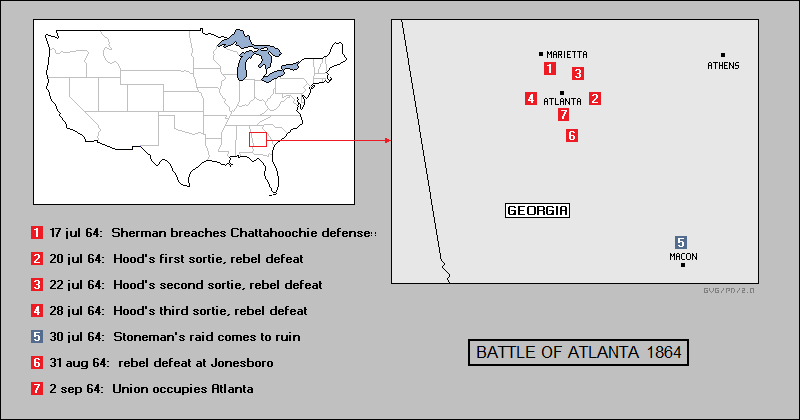
* Apprehensions had been growing in Atlanta over the past few weeks as Sherman's troops had moved steadily south. Citizens had been fleeing the city, whose parks had been turned into field hospitals. Transportation was hard to come by, since the trains were being used by the military to ship out the wounded as well as vital stores and machinery. There was a worry that Johnston meant to abandon Atlanta. Georgia Governor Joe Brown had written Richmond a few weeks earlier: "This place is to the Confederacy what the heart is to the body. We must hold it."
Johnston was at a loss. His only hope of inflicting serious injury on the mighty Federal army before him was for Sherman to throw it at strong rebel defenses, where the masses of Union infantry would be cut to pieces. Sherman's limited and unsuccessful experiment at Kennesaw Mountain made it very unlikely that he would repeat that blunder.
Johnston thought that the best plan was for Morgan or Forrest to cut Sherman's rail lifeline, forcing the Yankees to either attack at a disadvantage or withdraw before they starved. Johnston felt that Wheeler could not be spared for such a raid, since cavalry was needed to keep an eye on Sherman's movements and provide a mobile reaction force to respond to Federal probes. The problem was that neither Morgan nor Forrest were in any position to help, though for entirely different reasons.
Morgan had basically shot his bolt for good during his bungled raid into Kentucky, and Richmond wasn't inclined to trust him again even when the situation was becoming desperate. As far as Forrest went, Confederate intelligence knew that three Union three divisions had returned to Memphis from the Red River campaign and were now on the move, their intent and destination unknown. Forrest's commander, Stephen Lee, not only insisted to Richmond that Forrest couldn't be spared, but wanted to get back some of the troops the late General Polk had brought to Johnston's army.
Simply put, the Confederacy was now scraping the bottom of the barrel, while the Union's seemingly endless resources were mobilized against the South along all major fronts. Yankee trains continued to run down the track from Tennessee towards Atlanta without interference; if there was a wreck, the locomotive and cars were simply shoved off to one side to let others come through. Wheeler's cavalry did make pinprick raids to try to cut the railroad, but it was well protected by Federal cavalry and detachments of infantry, who were no longer so easily bamboozled by Confederate raiders, and not taken unaware. What damage Wheeler's cavalrymen did was quickly repaired by the extraordinarily efficient Federal railroad crews, who had rebuilt the span over the Chattahoochee in less than five days.
* Johnston could also hope that Sherman might be careless and separate his three armies too widely, inviting attack in detail. On hearing of Schofield's crossing of the Chattahoochee on 9 July, Johnston felt that Sherman had given him such an opportunity.
Johnston prepared for his counterstroke, but days passed and it didn't happen. Braxton Bragg had come to Atlanta to survey the situation and report back to Jefferson Davis. Johnston did not respect nor trust Bragg, who further damaged his credibility by foolishly insisting his visit was unofficial in nature. Johnston said as little as possible to his visitor. Bragg got an earful from John Bell Hood, little of which was flattering to Johnston, and unsurprisingly Bragg's report back to Richmond indicated that Johnston would almost certainly continue his policy of falling back. On 16 July, Jefferson Davis wired Johnston to ask what the plan was for the defense of Atlanta.
All Johnston could give in response was vague generalities. The pressure to remove him was becoming overwhelming. However, despite the bad history between Johnston and Jefferson Davis, Davis was very reluctant to change commanders of an army in the middle of a crisis. The only candidate available to replace Johnston was Hood, and he was a big gamble. On 12 July, Davis had wired Robert E. Lee, asking for an opinion of Hood as a replacement for Johnston. Lee responded directly in a telegram:
   I REGRET THE FACT STATED.  IT IS A BAD
   TIME TO RELEASE THE COMMANDER OF AN ARMY
   SITUATED AS THAT OF TENNESSEE.  WE MAY
   LOSE ATLANTA AND THE ARMY TOO.  HOOD IS
   A BOLD FIGHTER.  I AM DOUBTFUL OF THE
   OTHER QUALITIES NECESSARY.
Lee sent Davis a letter a short time later, repeating the same points, suggesting that the best course of action would be to concentrate Confederate cavalry in the region on Sherman's vulnerable supply railroad, and gave a more detailed appraisal of Hood: "Hood is a good fighter, very industrious on the battlefield, careless off, and I have had no opportunity of judging his action when the whole responsibility rested on him. I have a high opinion of his gallantry, earnestness, and zeal. Genl. Hardee has more experience in managing an army."
Hood had graduated from West Point near the bottom of his class, coming uncomfortably close to expulsion, and the severe injuries he had taken in combat had done nothing to make his thinking clearer -- all the more so because he was probably taking opiates to relieve the pain. However, Davis was stuck: Atlanta couldn't be given up without a fight. There might be no way to win such a fight, but to not make the fight was equivalent to surrender, and Davis simply couldn't conceive of it. Ironically, those in his cabinet who had backed Johnston seven months previously, particularly Secretary of State Judah Benjamin, now felt betrayed and were the loudest in demanding his removal.
On the night of 17 July, Johnston got a telegram from Richmond ordering him to turn over command to John B. Hood. Johnston wrote an emotional address to deliver to his troops, and sent an icily scornful reply to Richmond. Hood, on receiving the news, found himself having second thoughts about taking command since Sherman seemed to have the rebel Army of the Tennessee backed up against the wall, with the Federals poised to attack immediately. The next morning, 18 July, Hood met with Lieutenant General Alexander P. Stewart, who had recently been promoted from a division in Hood's own corps to take over command of the corps of the late General Polk from General Loring. The two generals tried to talk Johnston into staying on until the Battle of Atlanta was determined, but he would have none of it, replying: "Gentlemen, I am a soldier. A soldier's first duty is to obey."
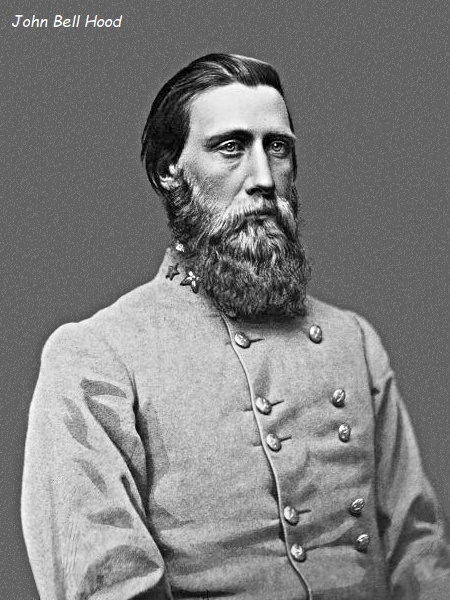
When Hood and Stewart met Hardee, the three of them sent a telegram to Jefferson Davis asking that the change in command be postponed. Davis quickly replied, saying bluntly that he hadn't wanted to make such a decision in the first place, had only done so because the necessity seemed so obvious, and wasn't about to change it. Hood went back to Johnston and tried to prevail on him to stay and help. Hood claimed that Johnston agreed to assist, but whatever the case Johnston went into Atlanta and took a train to Macon, Georgia.
Johnston had read his farewell address to the men that morning. The men and officers wept. They were collectively thrown into gloom by the loss of their commander, and the general feeling was that Richmond had done Johnston a great wrong. Hardee was upset as well, not just at the loss of Johnston, but at the idea that Hood was to be his new boss. Hardee was technically senior to Hood, didn't think much of his generalship, and immediately sent a request to Jefferson Davis for a transfer -- saying that the fact that he had refused command six months earlier didn't mean he had renounced it for all time. Davis persuaded Hardee to withdraw the request. Other senior officers in the army were just as doubtful of Hood. Pat Cleburne said: "We are going to carry the war to Africa, but I fear we will not be as successful as Scipio was."
* The news was printed in an Atlanta newspaper that day, 18 August, and a copy of that newspaper was in Sherman's hands the following morning, courtesy of a spy. Both McPherson and Schofield had been classmates of Hood's at West Point, and in fact Schofield had tutored Hood in mathematics, preventing him from washing out. Schofield warned Sherman: "He'll hit you like hell, now, before you know it."
Sherman hardly needed the advice, having put his forces on alert to prepare for an attack, but he was far from intimidated. A Federal officer from Kentucky who had known Hood in the prewar Army related that he had watched Hood play poker: "I seed Hood bet $2,500, with nary a pair in his hand." That was how Sherman sized up Hood as well. There would be hard fighting now, but what of it? The rebels would come out on the short end of that contest, shattering themselves against superior Union might. Sherman later accurately described Richmond's decision as having "rendered us most valuable service."
BACK_TO_TOP* To the west, in Mississippi, Stephen Lee's fears over Federal intentions in his domain had proven well-founded. Major General Cadwallader C. Washburn, Lee's Federal opposite number in Memphis, had taken Sherman's order to "follow Forrest to the death" to heart and dispatched A.J. Smith to do the job. Smith's three divisions were reinforced by Grierson's cavalry division and Bouton's brigade of black troops -- both of them with scores to settle with Forrest from the fiasco at Brice's Crossroads in June.
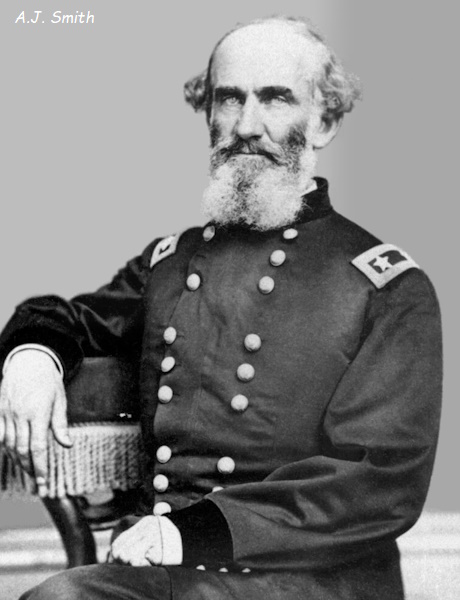
That gave Smith a force of 14,200 men in total, supported by six batteries of artillery and supplied with rations for twenty days. They moved out on 5 July, cutting a swathe of destruction through northern Mississippi as they advanced. Forrest's scouts were impressed with Smith's professionalism, reporting that they found "his column well closed up, his wagon train well protected, and his flanks covered in an admirable manner."
Forrest had about 6,000 troops, reinforced to about 8,000 when Stephen Lee rode in to take charge. Lee was in a hurry to deal with Smith, since reports were trickling in that Union Major General Edward Canby was preparing to advance on Mobile, Alabama, from New Orleans. However, the rebels were completely outnumbered by an adversary who they were not very likely to surprise or panic, and all they could do was harass the rear of Smith's march. By the evening of 13 July the Federals were in Harrisburg, just outside of Tupelo, where they settled in for the night, setting up stout defenses in expectation of a rebel attack.
Forrest was pleased to hear that, since he knew that Smith didn't have indefinite supplies and would eventually have to pull out, making the Federal column vulnerable to the sort of running, harrying, exhausting attack that Forrest had refined to an art. Stephen Lee liked the notion too, but he had to consider the threat to Mobile as well, and that meant dealing with the Federals immediately. Although Forrest objected, Lee ordered an assault at dawn. The Yankees were well set up and knew what they were doing, but Lee hoped that surprise and energy would compensate.
The attack demonstrated neither. After the sun came up on 14 July, there were delays and confusion, and the assault didn't jump off until 07:30 AM. Even then it was done piecemeal, with the only result of piling up dead and wounded rebels. In mid-morning Lee decided enough was enough, and called a halt to the attacks. He had lost about 1,326 men to Smith's 674 casualties. Shooting continued in an idle fashion the next morning, 15 July. At midday, Smith learned that most of the meat in his wagon train had spoiled and that he was low on ammunition; he immediately decided to pull out. His troops burned Harrisburg as they withdrew and marched back north the way they came, in the same tight and tidy order that had characterized their march south.
When they set up camp that evening 5 miles (8 kilometers) to the north, Forrest attacked in an attempt to put the "skeer" into them, but the Federals didn't take fright: they not only drove off his troopers but put a bullet into his foot, forcing him to give up command and seek medical attention. These weren't the same Yankees he had run circles around in the past.
Smith continued his withdrawal the next day, making arrangements for a supply train to meet him on the march. The Federals were back in Tennessee on 21 July. Smith and Washburn were both pleased with the results of the expedition, since for the first time the Yankees had taken on Forrest, done him far more damage than he had done them, and returned in good order.
Sherman was not at all pleased: he didn't want Forrest bloodied, he wanted him in a pine box. As long as Forrest was alive and capable of raising hell, Sherman's supply lines in middle Tennessee and the whole Atlanta campaign were at risk. Smith unhappily swallowed Sherman's reprimands and threw himself into planning a second excursion into northern Mississippi that would put Forrest down once and for all.
BACK_TO_TOP