
* The replacement of Joe Johnston by John Bell Hood in the defense of Atlanta did the Confederacy no good. From late July Hood's men engaged in several battles with Sherman's troops, the Confederates getting the worst of them. Confederate cavalry fared better against the Yankees, but could not halt the Union push. Hood was forced to withdraw, with the Federals marching into Atlanta on 2 September. The fall of the city energized the North and demoralized the South.

* John Bell Hood was an uncomplicated man who liked to fight; he was not noted for subtlety or insight. The Confederate government had selected him to command the Army of the Tennessee on that basis, and under those circumstances it was unsurprising that he decided to fight after only a day in his new position. He called a council of war with his corps commanders -- Hardee, Alexander Stewart, and Ben Cheatham, who had taken Hood's place at the head of his corps -- and instructed them to take the offensive at 1:00 PM the next day.
Union Generals Schofield and McPherson and their armies were moving on Decatur, Georgia, 5 miles (8 kilometers) to the east of Atlanta, with Schofield on the northern side of the drive and McPherson on the southern. In the meantime, George Thomas was moving his army across Peachtree Creek, 4 miles (6.4 kilometers) to the north of the city. Sherman was now moving to encircle Atlanta, and Hood thought he had a chance to catch the Union forces separated, strung out, and vulnerable. Cheatham, braced by Wheeler's cavalry, would perform a holding action on McPherson and Schofield to the east, while the other two corps drove north to hit Thomas as hard as possible.
For whatever reason, Hood ordered that the assault begin at the late hour of 1:00 PM on 20 July, but it actually went forward at 3:00 PM. The delay was disastrous. Old Slow Trot Thomas had all his people across Peachtree Creek, and they were already partly dug into defenses that made the best use of terrain. The Yankees were actually taken off guard, with some regiments running off toward the rear in disorder, but the Federals quickly rallied and stood fast. Hardee's push was thrown back, as was Stewart's just to the west. Hardee was going to commit Pat Cleburne's division, but Hood ordered that reinforcements be sent over to help Cheatham, whose "holding action" wasn't going well. Cleburne took his men over to brace up the defense to the east, and the battle flared along both the northern and eastern sectors until darkness put a stop to it.
The fighting had been hot enough to even get Pap Thomas excited for a while, but the "Battle of Peachtree Creek", or "Hood's First Sortie", was a flat failure for the Confederates, with Hood losing 2,500 men to Union casualties of 1,600. That would have been bad enough had the two armies been more equal, but the casualties inflicted on the bigger Union force were hardly enough to make the Yankees slow down. Hood blamed the fiasco on Hardee, complaining that Hardee had moved slowly and timidly, with Hood citing the much greater losses of Stewart's corps as proof.
* Fighting continued on the next day, 21 July, with Cheatham and Cleburne on the defensive, trying to hold back intense pressure from McPherson and Schofield to the east. Cleburne found McPherson's rifled artillery particularly accurate and deadly. However, that morning Wheeler's cavalry had detected that McPherson's southern flank was unguarded, and Hood eagerly jumped at the opportunity to hit the Federals by surprise.
In any case, Sherman was pushing Hood so very hard that his only choice was to attack, or withdraw from the city. Hood did pull his troops back that evening to defenses on the outskirts of Atlanta, prepared at Joe Johnston's order weeks before, but also ordered Hardee to take his corps on a night march through Atlanta and then on a loop south of the city that would finally end up on McPherson's flank. Hood had swallowed his reservations about Hardee for the moment.
Cleburne's division would join the three divisions of Hardee's corps to lend more power to the flanking attack. In the meantime, Wheeler's cavalry would destroy McPherson's wagon train, parked near Decatur, and if Hardee's attack were successful, both Stewart and Cheatham would sally out of their entrenchments to assist in the destruction of McPherson's army and prevent him from receiving assistance from other Union forces.
The flanking attack was supposed to take place at dawn on 22 July, but Hood's rearrangements of the rebel Army of the Tennessee were complicated to begin with, and his troops had been thoroughly worn out by days of hard fighting in the hot July sun. The assault didn't get off until about 12:30 PM, and immediately ran into trouble.
If McPherson's flank had been completely unprotected the morning before, it wasn't now. McPherson had detached a two-division corps under Major General Grenville Dodge to protect his flank. As luck would have it, Dodge was right in the path of Hardee's push, and set up a three-deep fighting line. The rebels weren't expecting to run into Yankees just yet, and the landscape was so covered with brush that they weren't aware of Dodge's defensive line until they emerged into the open to run into heavy volleys of rifle fire. Hardee's three divisions were stopped in their tracks, with one of the division commanders, Major General William H.T. Walker, shot off his horse and killed before he knew what was going on. The rebels tried to rally and attack again, to no better result.
Only Cleburne's Arkansas division found the way clear, and immediately exploited the opportunity with their accustomed aggressiveness by falling on the flank of Frank Blair's division. McPherson was conferring with Sherman at a house in the rear when the shooting broke out, and the younger man immediately jumped on his horse to find out what was going on, followed by his staff. McPherson quickly realized that Dodge was holding fast, and so he went on to Blair's division to see what was happening.
He found out the hard way. Cleburne's troops had forced Blair's division back, driving a wedge between Blair and Dodge, and were pushing hard into the gap. By bad luck, McPherson ran into a group of Cleburne's men. He coolly tipped his hat to them, and then tried to gallop off to escape. They shot him through his chest, knocking him off his horse. He lingered for a time and then died. He was 35 years old.
Sherman received news that McPherson's horse had come riderless out of the woods. He ordered Major General John Logan to take over command and deal with Cleburne's men. Sherman also sent a division from Schofield to deal with Wheeler's attack on McPherson's wagon train, but sent no other reinforcements. Sherman would be criticized for this after the battle, and also for not ordering Thomas and Schofield to push on the hollowed-out Atlanta defenses. Swallowing his irritation at rear-area strategists who had little idea of what a battle was like, he simply replied that he felt McPherson's men could hold their own, and besides they had something to prove to the insolent rebels who had killed their popular commander.
"Black Jack" Logan was actually a congressman who had put on a uniform; there were a number of such "political generals" in the war -- but unlike most of them, he had warrior's instincts and the loyalty of his men. He rallied his troops to hold, then made counterdrives that pushed the rebels back with heavy casualties. The Federals quickly recovered McPherson's corpse. The Yankees fought with determination, chanting "BLACK JACK! BLACK JACK!" as they moved against the rebels, totally intent on crushing them.
At about 3:30 PM, Hood ordered Cheatham to attack. His troops made some progress at first, denting the Federal line, only to then be pushed right back in hard fighting. The fact of the matter was that the rebels had shot their bolt and lost the battle, though they didn't give up easily. On the southern flank of the fighting, one Alabama regiment repeatedly attacked an Iowa regiment that was protected by earthworks -- the attackers being shot down in numbers with every attempt. The rebel commander, Colonel Harris D. Lampley, led a charge right up to the Yankee works, taking a wound and screaming abuse at his men for failing to follow him. The commander of the Federal regiment, a hefty fellow named Colonel William W. Belknap, simply reached over the breastworks, a bullet tearing through his beard, snatched Lampley by the collar, and hauled him inside. Belknap roared angrily at Lampley: "LOOK AT YOUR MEN! THEY ARE ALL DEAD! WHAT ARE YOU CURSING THEM FOR?!"
The fighting finally faded out in the dark. The next day, 23 July, the two wounded armies faced each other, with little inclination to renew the fight for the moment. That night, Hardee withdrew back into the Atlanta defenses.
The "Battle of Atlanta" or "Hood's Second Sortie" was an even bigger disaster than Hood's first go at Sherman, with the rebels losing about 8,000 men to about 3,700 Yankees. Cleburne had lost 40% of his troops. The attack might have actually succeeded had Dodge's corps not been in the right place at the right time, but war is a contest of both luck and skill, and Hood was simply not very lucky. He refused to admit that he had been defeated, claiming a "partial success" and insisting that the battle had done much to improve morale.
The killing of McPherson was a widespread shock to the Federals, and even Hood was shaken at the death of his old schoolmate. Sherman, an emotional man, was in tears. Like a cliche in a war story, McPherson had been trying to find an opportunity to take leave and get married, and Sherman wrote the bereaved woman an effusive letter about their "dead hero" and "that bright particular star." Later, he would write about McPherson in a more characteristic style: "I expected something to happen to Grant and me; either the rebels or the newspapers would kill us both, and I looked to McPherson as the man to follow us and finish the war."
* McPherson was gone; Sherman now had to consider the dead general's replacement for command of the Union Army of the Tennessee. Although Black Jack Logan looked like the prime candidate and was respected for both his leadership and fighting spirit, the unassertive Thomas told Sherman that he would not be able to work well with the overly-assertive Logan, and suggested that an officer with a professional background would be more appropriate. Sherman agreed to that extent, saying that politicians in uniform tended to be excessively interested in covering themselves with glory to further their political careers. In fact, other officers found Logan to have an annoying flair for the dramatic, one saying that he "always played to the gallery." Sherman asked Thomas to suggest a candidate, and Thomas suggested one-armed Major General Oliver Otis Howard instead.
Howard was certainly professional, though he was very sanctimonious; the rough Westerners called him "Old Prayer Book". Furthermore, his earlier commands back East had been marked largely by disasters and routs. Sherman worried that appointing Howard would make Logan "mad as hell", but then went ahead and did it anyway.
Logan was upset, though he kept a lid on it, but it was just too much for Joe Hooker. Hooker hadn't even been a candidate for the job; however, he had looked down on Howard's generalship and technically ranked him. Hooker described the appointment as "an insult to my rank and services" -- and immediately submitted his resignation. Thomas cheerfully forwarded the resignation to Sherman, and Sherman accepted the resignation without hesitation, no doubt thinking that his decision to assign Howard to the command was already paying dividends.
Hooker was actually very popular with his own men, and some of them wept bitterly on hearing the news of his departure. He went north to a non-combat command and out of the war for good. To grind in the indignity, Hooker was replaced in command of his old corps by Major General Henry W. Slocum. Slocum was another one of Hooker's enemies; the feelings between them were so bitter that Slocum had been transferred to Vicksburg before the beginning of the Atlanta campaign just to keep the two from each other's throats.
* Now Sherman strengthened his grip on Atlanta. His railroad was pouring war materials into a forward base just behind Thomas's lines. The next move was obvious. The Yankees held the rail line to the north, they had torn up the tracks to the east, and Atlanta's only lifeline was now the rail connection leaving the city from the southwest, the Macon & Western. Even this line wasn't fully operational. Outside the city, it split into branches, one going west to connect to Montgomery and Mobile, and the other splitting off to go east to Savannah; a Federal cavalry force of 2,500 troopers under Major General Lovell Rousseau had ranged through Alabama the week before and put the western connection out of business.
All that was left to cut was the last connection to Savannah. The plan was straightforward: Howard would shift his army behind Schofield and Thomas in a westward arc around the city, with the other two armies following behind. Sherman's cavalry would play an independent role in this move, with two columns riding to the southwest of the city to cut the railroad.
One column of 3,500 cavalry was under Brigadier General Edward McCook, while the other consisted of 6,500 troopers under Major General George Stoneman, including Garrard's division of 4,300. Stoneman wanted to extend the raid to free Union prisoners at Macon and Andersonville, and Sherman granted him permission, though on the condition that Garrard's force not be included in the extension of the raid.
The big move jumped off on the morning of 27 July. Schofield and Thomas demonstrated fiercely to keep up the pressure on Hood in Atlanta, while Howard took the Army of the Tennessee on its arc around the rear. Federal shells dropped on Atlanta and its defenses, while the two columns of cavalry set off across the country.
The cavalry raid quickly ran into trouble. Joe Wheeler only had 6,000 cavalry in eight brigades to oppose 10,000 Federal troopers, but the Yankees were split in two, inviting attack in detail. Furthermore, politicians in uniform weren't the only ones who had an excessive interest in covering themselves in glory: Stoneman had become so fixated on the headlines and medals he would win for freeing thousands of Union prisoners that the actual goal of the raid, to cut the rail connection to Savannah, became a second priority at best.
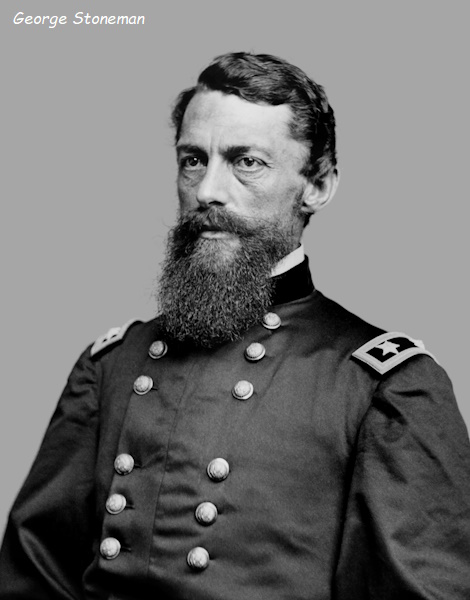
Knowing that Garrard's cavalry division couldn't accompany him on this ride to glory, Stoneman ordered Garrard to take his troopers due south, while Stoneman took the remaining three brigades to the southeast. Now there were three separated columns, not just two, and Wheeler was quick to exploit the opportunity. Garrard ran into Wheeler's entire force and was thoroughly spooked, taking his men back to Federal lines as fast as they could ride. Recognizing Garrard's movement as the diversion it was, Wheeler ordered one of his eight brigades to pursue and keep Garrard running. Wheeler ordered three other brigades to chase Stoneman, and then led the remaining four brigades to fall on McCook.
McCook had been tearing up track to the east of Jonesboro and was riding back to Union lines when Wheeler jumped his force and surrounded it. The Federals managed to break out, with heavy losses. McCook made it back to Union lines on 30 July, less 950 of his men, his pack train, and two guns. Although McCook had destroyed a large Confederate wagon train, the damage to the railroad was minimal and quickly repaired.
On that same day, Stoneman was poking at Macon, finding it defended by local militia. While he was considering how to deal with that obstacle, the three brigades sent by Wheeler fell on him and forced him to flee. He decided to make a stand with one of his brigades while the other two tried to get away. The rearguard brigade was gobbled up wholesale, with many of the 700 men taken prisoner, including Stoneman. One of the other two brigades managed to get back to Union lines, but Wheeler caught up with the other at Jug Tavern on 3 August and crushed it as well. Stoneman ended up in prison in Macon, in need of rescue himself. He was the most senior Union officer captured by the Confederates. Sherman wired Washington:
   ON THE WHOLE, THE CAVALRY
   RAID IS NOT DEEMED A SUCCESS.
Whatever the disappointment, Sherman had bigger things on his mind for the moment. Howard's counterclockwise move around Atlanta had gone quietly on 27 July, but on the morning of 28 July, the Federals came under fire from a hidden battery, just north of Lickskillet Road, due west of the city. Howard and Sherman were riding together, and Howard said: "Hood will attack me here." Sherman thought Hood had exhausted himself with his previous two sorties, and replied contemptuously: "I guess not. He will hardly try it again." Howard didn't buy that; he had been another one of Hood's West Point classmates, describing the Texan as "indomitable", unable to give up no matter what the odds.
Black Jack Logan's troops were leading the advance. Logan's force consisted of his corps, reinforced by a division from Grenville Dodge's corps, Dodge himself having been grazed on the forehead by a bullet the week before and out of the fighting for the time being. Howard, expecting trouble, told Logan to halt near a rural chapel named Ezra Church and have his men throw up a breastwork of logs as fast as they possibly could. The soldiers even stripped out the pews of the church to help build their defenses.
Howard's assessment of Hood was perceptive. Hood planned to set up his old corps -- now under Stephen Lee, who had been promoted to lieutenant general and brought from Mississippi to take over for Cheatham -- in the Federal line of march to perform a holding action, while Stewart took his corps and circled around for a flank attack on Howard from the southwest. Hardee would remain in the Atlanta defenses to block any push by Thomas or Schofield into the city's defenses. Hardee's corps had been reduced by a division, the cut-up brigades of the late Walker's division having been parceled out to the other three divisions in the corps.
Howard's army had been moving rapidly, and Lee found the Yankees coming on before his own corps had found time to dig in. Lee didn't want to run, didn't want to stay there and be overrun -- so he took the only option he had left, ordering his three divisions to charge the Federals. This might have worked had the Federals been taken by surprise, but they were even more alert than they had been on 22 July. Logan's hastily-built breastworks were solid enough to stop Lee's charge cold and throw the rebels back with heavy losses. Sherman heard the sounds of firing and said: "Logan is feeling for them, and I guess he has found them."
When a messenger arrived to give more details, Sherman was delighted, replying excitedly in a singsong: "Just what I wanted! Tell Howard to invite them to attack! It will save us trouble! Save us trouble! They'll only beat their brains out! Beat their brains out!" Sherman was absolutely correct. Lee tried again, repeatedly, only to find stronger defenses and more Yankees with every attempt. A Union soldier wrote later: "Each attack was less vigorous and had less chance than the one before it."
Stewart, realizing that Lee would probably be crushed before a flank attack could be launched, came to Lee's assistance. Stewart managed to get one division into the fight before nightfall put an end to the shooting, with little result other than to increase rebel casualties. Hardee had arrived by that time, having been ordered by Hood to go out and take charge personally while Cheatham took command of the troops in the Atlanta defenses. All Hardee could do was deal with the flood of casualties.
The rebels had lost thousands to hundreds of Union casualties. Hardee found his troops totally demoralized by the botched assault. A tale would make the rounds later of banter between a Yankee picket and a rebel picket in the course of Hood's defeats, with the Yankee asking: "Say, Johnny, how many of there are you left?"
The rebel picket replied: "Oh, about enough for another killin'."
Hood no longer had the resources to think he could defeat Sherman and his troops, who were thoroughly canny opponents in any case. Despite the fact that the "Battle of Ezra Church" or "Hood's Third Sortie" had been an unarguable, one-sided Union victory, Sherman wasn't going to take the chance that Hood might get lucky with another one of his rash assaults, and the failure of Union cavalry probes to cut off Atlanta had made Sherman cautious. Sherman decided to move methodically and tighten his grip around Atlanta by degrees. After all, it wasn't like the city was going anywhere.
BACK_TO_TOP* Sherman's unhappiness with the inconclusive results of A.J. Smith's expedition into northern Mississippi in July made Smith particularly thorough in his plans for a rematch with Bedford Forrest. Smith put together a force of 18,000 men, planning an offensive along the Mississippi Central Railroad line, with work crews making sure that the trains could keep Smith's troops supplied with boots, beans, and bullets. Smith's boss in Memphis, Major General Cadwallader Washburn, sent a message to Sherman saying that Smith's army could "whip the combined force of the enemy this side of Georgia and east of Mississippi." Washburn said that Smith would depart as soon as possible, and added that reports were trickling in that Bedford Forrest was already dead.
The reports were exaggerated -- but Forrest wasn't doing well, having been ill even before being wounded in the foot during the July fighting. He was about as unhappy as such a tough case could get, humiliated by his poor showing against Smith, and acutely aware that the 5,000 troopers he had on hand would not be much of an obstacle when the Yankees came back in earnest. Stephen Lee had thrown away too many of Forrest's men in the futile battle at Harrisburg, and then taken more of them south to Mobile. They turned out to be unneeded there, Canby's plans to seize the city having been frustrated by the transfer of Emory's XIX Corps to Virginia. That wasn't any relief to Forrest, since Lee then took his troops to Atlanta in time to keep an appointment with defeat at Ezra Church.
In Lee's absence, command of the district fell temporarily to Major General Dabney Maury, until Richmond could figure out a formal replacement. Maury had the sense to give Forrest the authority to do what he thought best to defend his territory.
Smith moved south in the first days of August, with the Federals and the rebels making contact on 8 August. All Forrest could do was fight delaying actions that didn't cause Smith much bother. However, on 10 August the rain started to fall, to continue for a week, unusual for Mississippi in August. Smith's advance stalled while the rains fell. On 18 August, the rains stopped; although the roads were still wet, Smith began to push on again. It took him two days to realize that Forrest was gone.
Forrest knew that Smith would renew his advance once the rain stopped. Forrest realized he was going to lose a fight on those terms, and so he moved out on a raid into Smith's rear on 18 August. He had left Brigadier General James R. Chalmers to demonstrate in front of Smith as a deception. By the time Smith began to suspect something wasn't right, Forrest and his troopers were already in Tennessee, having sent work parties ahead to improvise bridges across swollen streams.
The raiders were headed for Memphis, spies having informed Forrest that the city's defenses had been stripped to reinforce Smith's push into northern Mississippi. Forrest's action was bold and his people were enthusiastic. Forrest later said: "I had to continually caution the men to keep quiet. They were making a regular corn shucking out of it."
Just before dawn on Sunday, 21 August, Forrest's troopers swept into Memphis. His force was divided up into a number of detachments, each with specific objectives. A particular objective was to capture Washburn, as well as Brigadier General R.P. Buckland, the commander of the city garrison, who were both living in commandeered houses in the city. For good measure, Forrest also sent a detachment to snatch up Washburn's predecessor, Stephen Hurlbut, who was staying in a hotel waiting for reassignment.
Things didn't work out exactly as planned. The raiders encountered a little opposition, not enough to stop them but enough to wake everyone up. Buckland and Washburn were able to run off, though Washburn didn't have enough time to dress. Hurlbut wasn't at the hotel, since he had spent his night elsewhere, leading to speculation in the press later as to who he was spending his night with. Hurlbut would get a bit of satisfaction out of the whole incident, saying: "They removed me from command because I couldn't keep Forrest out of West Tennessee, and now Washburn can't keep him out of his own bedroom."
Bedford Forrest's brother Jesse did capture two of Washburn's staff officers and took Washburn's dress uniform as well. The rebels also raised perfect hell in Memphis, which was the real objective of the raid. The raiders pulled out in mid-morning, 35 Confederates having been wounded or killed versus 80 Federal casualties. The rebels also captured 116 prisoners and 200 valuable horses.
Bedford Forrest was not pleased when brother Jesse proudly showed him Washburn's uniform; Bedford Forrest had absolutely no starry-eyed notions of military chivalry in him, but stealing a uniform was juvenile, and he ordered the uniform sent back across the lines under a flag of truce. Some weeks later, a Yankee courier would pass a package back to him under another flag of truce. It contained a neat gray Confederate uniform, made at Washburn's expense by a Memphis tailor who had clothed Forrest before the war and had his measurements.
* The raid worked as planned. Hysterical reports of Forrest running wild in West Tennessee forced Smith to give up his offensive and backpedal rapidly, closely shadowed by Chalmers and his men. Of course, by the time Smith got back to Tennessee, Forrest was long gone.
Both Washburn and Sherman made light of the raid on Memphis. Forrest's men hadn't had time to do much damage or grab much loot -- and as long as they were raiding Memphis, they weren't cutting Sherman's supply line. Sherman wired Washburn on 24 August:
   IF YOU GET THE CHANCE, SEND WORD
   TO FORREST THAT I ADMIRE HIS DASH
   BUT NOT HIS JUDGEMENT.  THE
   OFTENER HE RUNS HIS HEAD AGAINST
   MEMPHIS THE BETTER.
That was part truth, part bluster. Smith's mission to "follow Forrest to the death" had been thoroughly derailed. Sherman was back at square one, with Forrest able to ride where he liked and leaving no peace as long as he remained alive. For the moment, however, Sherman had no reason to be concerned about Forrest, who had returned to Mississippi and was not involved in the defense of Atlanta.
BACK_TO_TOP* All through August, Sherman continued to draw a ring around Atlanta. He set up siege guns and pounded the city, forcing the inhabitants to pack up whatever they could carry and flee. Those who could not built bombproofs and hid.
Hood responded to Yankee pressure by sending Joe Wheeler north to cut the Western & Atlantic, on the belief that Sherman would then be forced to choose between withdrawal or starvation. Wheeler left on 10 August with 4,500 troopers, leaving about the same number behind with Hood to keep an eye on Sherman. The raiders spent a month in the saddle, moving fast and riding all the way north to Knoxville, tearing up rails and burning bridges, taking prisoners and fresh horses.
Wheeler achieved as much or more than he expected to, but as it turned out Sherman's work crews repaired the damage almost immediately, and the interruption of supplies never amounted to more than a nuisance to Sherman. The most significant effect of the raid was that Wheeler's glowing reports back to Atlanta, though generally true in detail, gave Hood the entirely false impression that the raid had been effective.
With half of Hood's cavalry gone north, Sherman took the opportunity to send his own cavalry again to cut the Macon & Western. Judson Kilpatrick was back in the saddle after recovering from his wound; Sherman didn't think highly of Kilpatrick, who had a surplus of ego and a deficit of sense -- but at least Kilpatrick liked a fight, while Sherman found Garrard timid in the extreme.
Kilpatrick set out on the evening of 18 August with his division and rode to Jonesboro, about 20 miles (32 kilometers) due south of Atlanta. He burned the depot there and started to tear up track, but Confederate forces converged on him, forcing him to return to Union lines at Decatur on 22 August. Kilpatrick gave a grand report of the raid that gave Sherman great satisfaction -- until news began filtering in that trains were running up the Macon & Western as if nothing had happened.
Sherman decided that his cavalry were simply not up to the job. Something more forceful was required, and in fact Sherman had already laid plans for what to do in case his horse troopers couldn't cut off Atlanta. He would break loose of his base of supplies, take six of his seven corps of infantry and conduct a wide, looping encirclement around the city. Howard's army would be on the outside of the loop, marching on an arc towards Jonesboro, while Schofield would take his army on a much shorter loop to the southern end of Atlanta's defenses, and Thomas would march up the middle. Thomas would leave Slocum's corps behind to protect the Western & Atlantic railhead north of the city.
* The movement began on 26 August. Much to Sherman's surprise, his troops encountered no real opposition. Hood hadn't hesitated to attack the Yankees during previous movements around the city and Sherman had been expecting a fight.
Hood was passive in the face of the movement because he had no clue of it. When the Federal siege guns went quiet on 26 August, rebel scouts reported back to Hood that the Yankees had pulled out of their entrenchments except to the north of the city. Hood, misled by Wheeler's reports of damage done to the Western & Atlantic, concluded that Sherman had been starved out and was withdrawing to the north. Hood ordered his cavalry to pursue the "withdrawal" -- but the troopers reported that although the Federals were on the move, they didn't seem to be retreating. Having no clear notion of the location, movements, and intent of a clearly superior enemy force would have given more thoughtful generals a certain amount of anxiety; Hood simply refused to believe the scouts.
It wasn't until the morning of 30 August, when Sherman's forces were within a few miles of the objectives of their roundabout march, that Hood realized his error and gave orders to prepare for the immediate withdrawal of all valuable stores from the city. He was still unsure of what Sherman was up to, believing that the "missing" Yankee force was split in half, with the half Hood could see serving as "bait" while the other unseen half fell on the rebels when they ventured out of the Atlanta defenses.
However, Hood was much too aggressive to be intimidated for long, and by midday he had decided that the wide movements of the Federals gave him an opportunity to attack them in detail. He ordered Hardee to take his corps on a night march to Jonesboro to attack the Union drive on the town at first light on 31 August. Stephen Lee would follow up Hardee's attack and help halt Sherman's forces in that area. That done, Lee would then loop back north with his corps and join Stewart with his corps in a devastating flank attack. Hardee was in overall command of the operation, with Cleburne moving up temporarily to take charge of his corps.
That was the plan. In reality, Confederate forces trying to move south out of the city found far more Yankees in their way than expected, forcing roundabout routes of march, and Hardee wasn't able to launch his assault until about 3:00 PM on 31 August. Even then, the attack was poorly coordinated, and Howard was not only expecting an attack, he had been trying to provoke one. There turned out to be many more rebels in Jonesboro than Howard had estimated, but that only made his effort more productive. The Federals were well dug in, the rebels were exhausted and demoralized, and Hardee's push didn't have a chance. The Yankees were so confident that they laughed at the Confederates as they moved up, cheered them on, and mocked them as they were thrown back, leaving their dead and wounded on the battlefield.
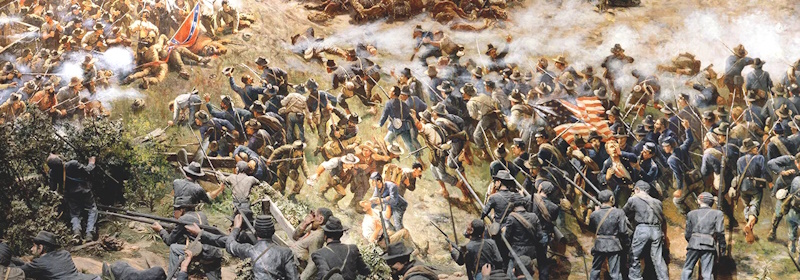
Cleburne's own division, under Brigadier General Mark Lowrey, hardly even got into the fight. As the rebels moved forward to hit the southern end of the Yankee line, they came under flanking fire by Kilpatrick's cavalry that was so annoying that the rebels had to take the time to drive the troopers off. The Confederates were angry at the Yankee cavalry and continued to chase them, even though they were no longer a real threat, while the rebel division's officers tried unsuccessfully to get them back on track. The rebels didn't stop until they ran into Yankee reinforcements, who countercharged and threw them back.
That was as much as the rebels proved capable of doing. Howard was very pleased at the work of Kilpatrick's cavalry, writing: "Nothing, even if I had planned it, could have been better done to keep an entire Confederate division away from the main battlefield."
The Confederates lost about 1,700 men to about a fourth that many Federals. Hardee wanted to renew the assault, but Stephen Lee's corps had suffered a disproportionate share of the casualties, and though Lee was aggressive, he had to tell Hardee his troops were in no shape for another push. Hardee put his troops on the defensive to prepare for a Union counterstroke, but Howard didn't press his advantage.
* Hood described the fight as "disgraceful" -- not because it was poorly conducted, but astoundingly because he believed the casualties too light. He thought Hardee had been too timid, though it seems hard to believe that any further effort would have accomplished any more than pile up even more Confederate corpses. Hood also thought the Federal attack was just a diversion, and that the Yankees were preparing to directly assault the Atlanta defenses.
On orders from Hood, Lee took his bloodied corps back north to Atlanta that night, dodging concentrations of Federals in his way that he was able to identify as elements of Thomas's and Schofield's armies. As obstinate as Hood was, even he was able to recognize that with almost all of Sherman's grand army on his rail lifeline, Atlanta was doomed. Hood began to plan a withdrawal. On the night of 1 September 1864 the troops of Slocum's corps were treated to a spectacular fireworks show as Hood's troops blew up railroad cars full of ammunition that they could not take with them.
The next morning, Slocum's troops were moving forward on Atlanta when they met a party of city officials under Mayor James M. Calhoun, who formally surrendered the city to the Yankees. The Federals marched into the city unopposed, with regimental bands blaring out music. It was an intoxicating feeling to the transplanted Easterners of Slocum's command. Although the old disdain of the Westerners had generally faded once it had become obvious that the Easterners were good fighting men, this was a triumph they hadn't had in either East or West. The local women set out buckets of water in hopes of placating their conquerors. The Stars & Stripes were raised over city hall, and Slocum wired War Secretary Edwin Stanton:
GENERAL SHERMAN HAS TAKEN ATLANTA.
For the moment, however, Sherman himself knew nothing of this, being out of communications while moving against the enemy. He had tried to bring most of his force to bear on Hardee's corps, isolated in Jonesboro, on 1 September, but in an odd parallel to the Confederate attack from the town the day before, the Federal assault got off way late and was disjointed.
The Federals made good progress at first, but then they ran into solid resistance and bogged down. The day ended with a loss of 1,275 Federals and a thousand rebels. It had been a nasty close-quarters fight, with both sides for once relying heavily on the bayonet. Sherman bedded down for the night, expecting to take a better shot at it in the morning, but the thunderous rumblings to the north in Atlanta kept him awake. He worried that Hood was using the opportunity to fall on Slocum and hit him hard.
Sherman still went forward with his renewed assault on Jonesboro after daybreak on 2 September, only to find out that Hardee had pulled out during the night. Johnston might be gone, but his custom of "clean retreats" had persisted. Sherman pursued Hardee south about 6 miles (10 kilometers) to Lovejoy Station, only to find, in another custom left over from Johnston, the rebels had set up perfectly impregnable defenses. A probe launched late in the afternoon was thrown back with heavy losses.
Although reports were filtering in that the rebels had pulled out of Atlanta, Sherman was still worried about Slocum and his corps. His fears were put to rest that night when he got a dispatch from Slocum confirming that the city had fallen. Sherman showed the message to Thomas, who "snapped his fingers, whistled, and almost danced." Apparently some of Sherman's exciteability had rubbed off on Thomas.
Sherman himself was not entirely happy. He had missed the chance to run roughshod over Hood's other two corps while they were on the move, and worse, had let them link up with Hardee. The defenses at Lovejoy Station in front of the Yankees were now filled by all of Hood's army, which though much weakened still represented a threat. From a strictly military point of view, the destruction of Hood's force was more important than taking Atlanta. Sherman swallowed his disappointment and wired Washington:
ATLANTA IS OURS, AND FAIRLY WON.
He told General Halleck that he would rest his troops for a few days before taking further action. Church bells rang out across the North, and Grant ordered that his guns fire a salute ... with live rounds into Lee's entrenchments.
* Hood blamed his defeat on his troops, who he accused of a lack of drive and courage. That was asinine, since he knew perfectly well that about 20,000 of his men had demonstrated their spirit with their blood since he had taken command. Robert E. Lee's judgement of Hood's abilities was correct: an excellent fighting officer, he had reached his level of incompetence in the command of a full army. He was not close to done proving it.
Although the failure to crush Hood left the capture of Atlanta a somewhat hollow victory to Sherman, in the broader view it had enormous consequences that were bad for the Confederacy and good for the Union. It was a devastating blow to Southern morale, all the more so because Southern newspapers had been making much of Hood's sorties, reporting them as enormous successes and concluding that Sherman and his army were just about on the edge of collapse. The bubble of optimism having burst completely, the citizenry were cast down to despair.
Of course, on the other side of the coin the victory was a tremendous boost to Northern morale. Abraham Lincoln was facing the national election contest in November, and things hadn't looked good for him; now his re-election was all but guaranteed. Antiwar sentiment, fed by frustration, had been gaining strength in the North; now it was rapidly fading. Southerners were, on their part, dejected, since the fall of Atlanta had made the approaching doom of the Confederacy evident to anyone who could stand to face reality. The only reason the war dragged on was a refusal to admit defeat.
BACK_TO_TOP* This document was derived from a history of the American Civil War that was originally released online in 2003, and updated to 2019. It was a very large document, and I first tried to simply break it into volumes for publication in ebook format; however, that proved unsatisfactory, and I decided to break it into separate focused volumes. This stand-alone document was initially released in 2025.
* Sources:
When I was interested in picky details, I'd scrounge the internet, particularly the Wikipedia, for leads.
* Illustrations credits:
Finally, I need to thank readers for their interest in my work, and welcome any useful feedback.
* Revision history:
   v1.0.0 / 01 dec 25
   v1.0.1 / 01 may 26 / Review & polish.
BACK_TO_TOP
